
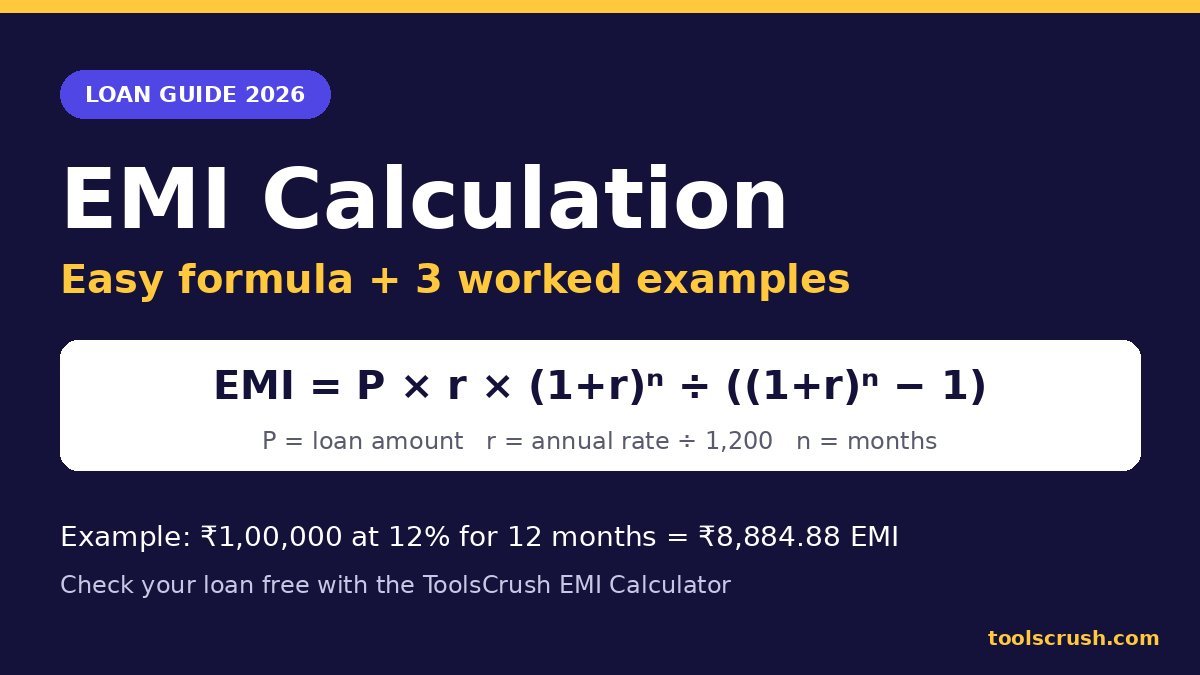
EMI calculation uses one formula: EMI = P × r × (1 + r)n ÷ ((1 + r)n − 1), where P is the loan amount, r is the monthly interest rate (annual rate ÷ 1,200) and n is the number of months. Example: ₹1,00,000 at 12% a year for 12 months gives an EMI of ₹8,884.88.
Last updated: October 2026
Skip the maths: the free ToolsCrush EMI Calculator shows your monthly EMI, total interest and total payment for any home, car or personal loan in seconds. No sign-up is needed.
Before you sign a loan offer, you should know what you will pay every month and how much of it is interest. This guide explains EMI calculation in simple English, works through 3 easy examples with exact numbers, and shows how tenure, interest rate and prepayment change what you pay.
What is an EMI and why does EMI calculation matter?
EMI means Equated Monthly Instalment. It is the fixed amount you pay your bank or NBFC every month until the loan is fully repaid. RBI describes an EMI as an equal repayment, made up of both principal and interest, that fully pays off the loan over a fixed number of months. Each EMI has two parts:
- Interest on the amount you still owe, and
- Principal, which reduces the amount you owe.
The EMI amount stays the same, but the mix changes every month. Early EMIs are mostly interest. Later EMIs are mostly principal. This is why the first few years of a home loan feel slow: the outstanding balance falls only a little.
Doing an EMI calculation before you borrow helps you in three ways. You can check that the monthly payment fits your budget. You can compare two offers on the true total cost, not just the headline rate. And you can plan prepayments that cut years off your loan.
EMI calculation formula explained
Every bank, NBFC and online calculator in India uses the same reducing-balance formula for EMI calculation on a standard loan:
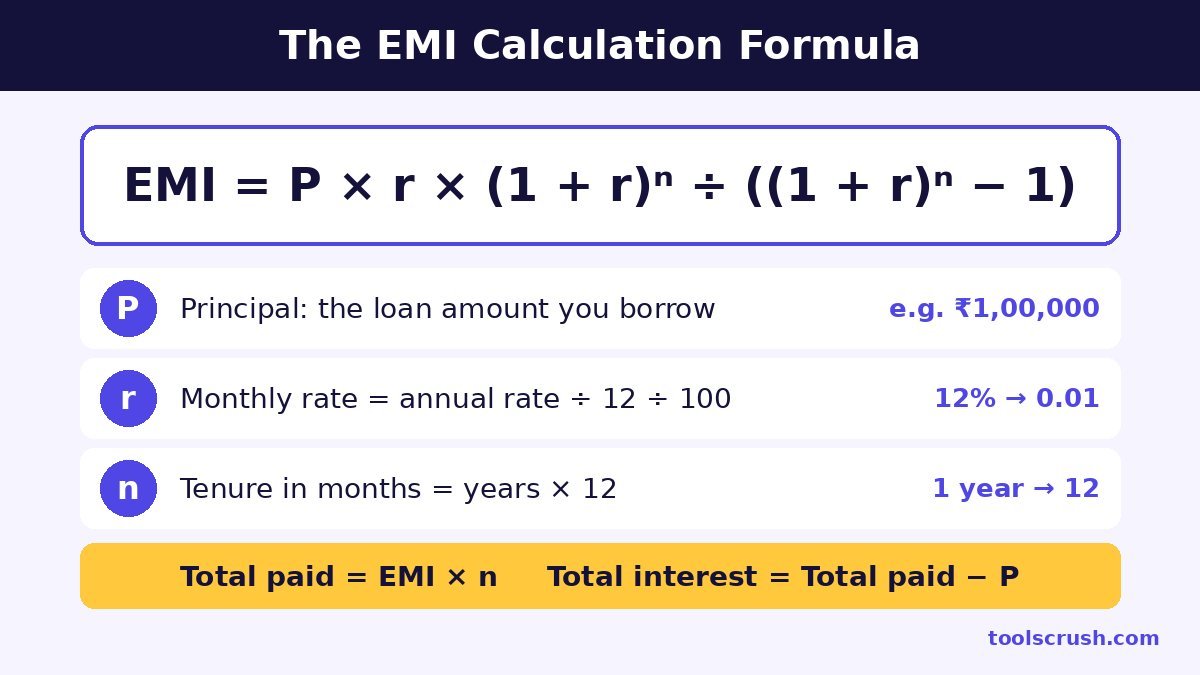
- P = principal, the loan amount you receive.
- r = monthly interest rate = annual rate ÷ 12 ÷ 100. For 9% a year, r = 0.0075.
- n = tenure in months = years × 12. For 5 years, n = 60.
- Total payment = EMI × n.
- Total interest = total payment − P.
The part (1 + r)n is the compounding factor. It grows quickly when the tenure is long, which is why a 20-year loan has such a large interest bill. You only need a phone calculator with a power key (xy) to finish the EMI calculation.
How to do EMI calculation step by step
Let us take a simple example: ₹1,00,000 loan at 12% per year for 1 year.
- Find the monthly rate: r = 12 ÷ 12 ÷ 100 = 0.01.
- Find the number of months: n = 1 × 12 = 12.
- Calculate (1 + r)n: (1.01)12 = 1.126825.
- Top part: P × r × (1 + r)n = 1,00,000 × 0.01 × 1.126825 = 1,126.825.
- Bottom part: (1 + r)n − 1 = 0.126825.
- Divide: 1,126.825 ÷ 0.126825 = ₹8,884.88 per month.
- Total paid: ₹8,884.88 × 12 ≈ ₹1,06,619, so the total interest is about ₹6,619.
Notice that the interest is ₹6,619, not ₹12,000. You repay part of the principal every month, so interest is charged on a shrinking balance. This is the single most important idea behind EMI calculation.
Try your own numbers: open the ToolsCrush EMI Calculator, enter the amount, rate and tenure, and compare it with your manual answer. They should match to the rupee.
3 easy EMI calculation examples: home, car and personal loan
The interest rates below are examples only, chosen to show the maths. They are not offers from any bank. Your actual rate depends on the lender, your credit score and the type of loan.
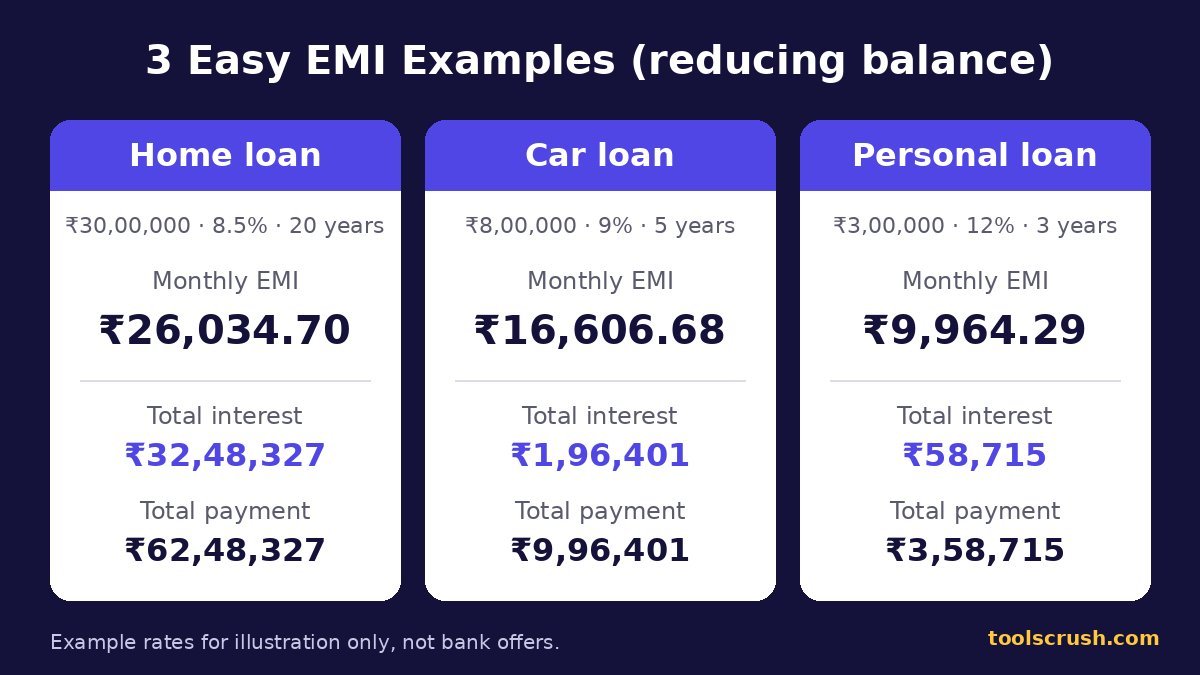
| Loan type (example) | Loan amount | Example rate | Tenure | Monthly EMI | Total interest | Total payment |
|---|---|---|---|---|---|---|
| Home loan | ₹30,00,000 | 8.5% p.a. | 20 years (240 months) | ₹26,034.70 | ₹32,48,327 | ₹62,48,327 |
| Car loan | ₹8,00,000 | 9% p.a. | 5 years (60 months) | ₹16,606.68 | ₹1,96,401 | ₹9,96,401 |
| Personal loan | ₹3,00,000 | 12% p.a. | 3 years (36 months) | ₹9,964.29 | ₹58,715 | ₹3,58,715 |
Example 1: home loan EMI
For ₹30 lakh at 8.5% for 20 years: r = 8.5 ÷ 1,200 = 0.0070833 and n = 240. (1 + r)240 ≈ 5.4412. This EMI calculation gives a monthly payment of about ₹26,035.
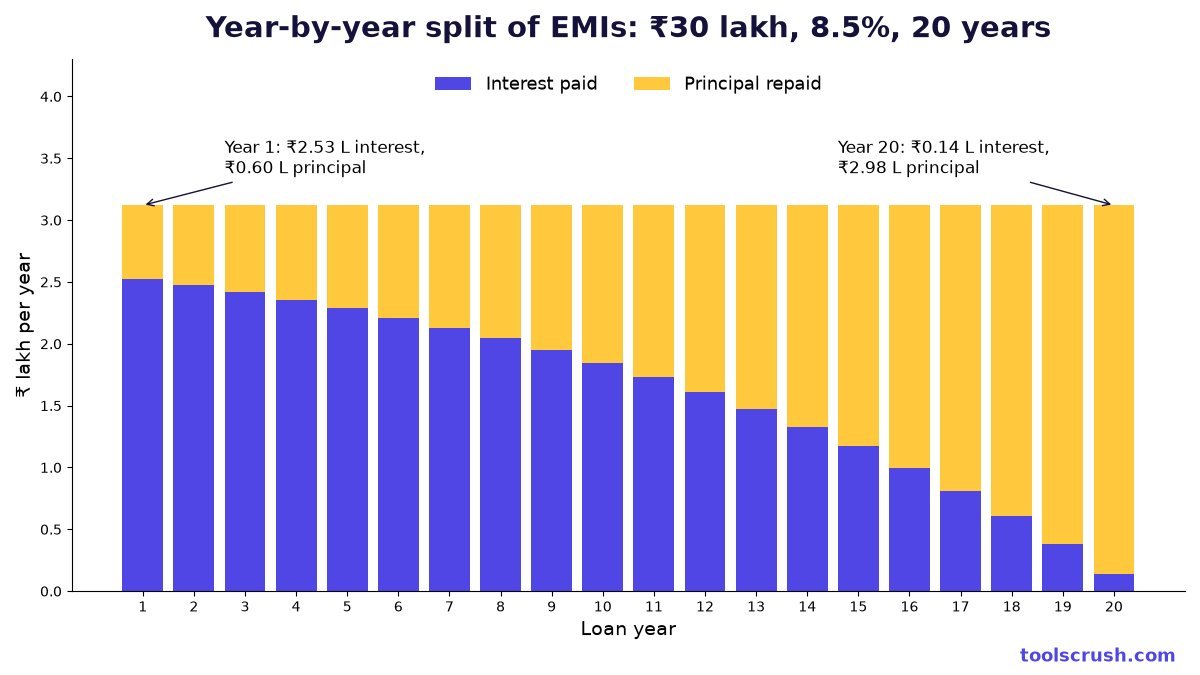
Over 20 years you pay about ₹62.48 lakh, so the interest (₹32.48 lakh) is more than the loan itself. In the first year alone, about ₹2,52,709 of your EMIs go to interest and only about ₹59,707 to principal. The principal part of the EMI overtakes the interest part only in month 143, almost 12 years into the loan.
Example 2: car loan EMI
For ₹8 lakh at 9% for 5 years: r = 0.0075 and n = 60. (1.0075)60 ≈ 1.5657, and the EMI is about ₹16,607. The total interest is about ₹1.96 lakh.
Car buyers often choose between tenures. A quick EMI calculation for the same ₹8 lakh at 9% shows the trade-off:
| Tenure | Monthly EMI | Total interest |
|---|---|---|
| 3 years | ₹25,440 | ₹1,15,832 |
| 4 years | ₹19,908 | ₹1,55,586 |
| 5 years | ₹16,607 | ₹1,96,401 |
| 7 years | ₹12,871 | ₹2,81,186 |
Stretching from 5 to 7 years lowers the EMI by about ₹3,700 but adds about ₹84,800 in interest. A shorter tenure means a higher EMI but much less total interest.
Example 3: personal loan EMI
For ₹3 lakh at 12% for 3 years: r = 0.01 and n = 36. (1.01)36 ≈ 1.4308, and the EMI is about ₹9,964. The total interest is about ₹58,715. Personal loans are usually unsecured, so rates are often higher than home or car loans. That makes a correct EMI calculation even more important before you accept an offer.
Month-by-month amortization schedule
An amortization schedule is a table showing how each EMI is split between interest and principal. It is the natural next step after an EMI calculation. Here are the first 12 months of the ₹3,00,000 personal loan above (EMI ₹9,964.29, monthly rate 1%):
| Month | Opening balance | Interest (1% of balance) | Principal paid | Closing balance |
|---|---|---|---|---|
| 1 | ₹3,00,000.00 | ₹3,000.00 | ₹6,964.29 | ₹2,93,035.71 |
| 2 | ₹2,93,035.71 | ₹2,930.36 | ₹7,033.94 | ₹2,86,001.77 |
| 3 | ₹2,86,001.77 | ₹2,860.02 | ₹7,104.28 | ₹2,78,897.50 |
| 4 | ₹2,78,897.50 | ₹2,788.97 | ₹7,175.32 | ₹2,71,722.18 |
| 5 | ₹2,71,722.18 | ₹2,717.22 | ₹7,247.07 | ₹2,64,475.11 |
| 6 | ₹2,64,475.11 | ₹2,644.75 | ₹7,319.54 | ₹2,57,155.56 |
| 7 | ₹2,57,155.56 | ₹2,571.56 | ₹7,392.74 | ₹2,49,762.83 |
| 8 | ₹2,49,762.83 | ₹2,497.63 | ₹7,466.66 | ₹2,42,296.16 |
| 9 | ₹2,42,296.16 | ₹2,422.96 | ₹7,541.33 | ₹2,34,754.83 |
| 10 | ₹2,34,754.83 | ₹2,347.55 | ₹7,616.74 | ₹2,27,138.09 |
| 11 | ₹2,27,138.09 | ₹2,271.38 | ₹7,692.91 | ₹2,19,445.17 |
| 12 | ₹2,19,445.17 | ₹2,194.45 | ₹7,769.84 | ₹2,11,675.33 |
In year one you pay about ₹31,247 as interest and repay about ₹88,325 of principal. Each month the interest part falls a little and the principal part grows a little. By the 36th EMI, only about ₹99 of the payment is interest. Small paisa differences can appear because of rounding.
Home loan amortization, year by year
For long loans, a yearly view is easier to read. This chart shows the ₹30 lakh, 8.5%, 20-year home loan:
| Loan year | Interest paid that year | Principal repaid that year | Balance at year end |
|---|---|---|---|
| Year 1 | ₹2,52,709 | ₹59,707 | ₹29,40,293 |
| Year 5 | ₹2,28,632 | ₹83,785 | ₹26,43,815 |
| Year 10 | ₹1,84,452 | ₹1,27,964 | ₹20,99,815 |
| Year 15 | ₹1,16,977 | ₹1,95,440 | ₹12,68,962 |
| Year 20 | ₹13,921 | ₹2,98,495 | ₹0 |
After 5 years of EMIs (₹15.62 lakh paid), you still owe about ₹26.44 lakh. This is not a mistake in the EMI calculation or by the bank. It is simply how reducing-balance loans work, and it is why early prepayments save so much.
Effect of tenure and interest rate on EMI calculation
Two levers change your EMI more than anything else: how long you borrow for and the interest rate. Both tables below use the same ₹30 lakh home loan.
Effect of tenure (rate fixed at 8.5%)
| Tenure | Monthly EMI | Total interest | Total payment |
|---|---|---|---|
| 10 years | ₹37,196 | ₹14,63,485 | ₹44,63,485 |
| 15 years | ₹29,542 | ₹23,17,594 | ₹53,17,594 |
| 20 years | ₹26,035 | ₹32,48,327 | ₹62,48,327 |
| 25 years | ₹24,157 | ₹42,47,044 | ₹72,47,044 |
| 30 years | ₹23,067 | ₹53,04,266 | ₹83,04,266 |
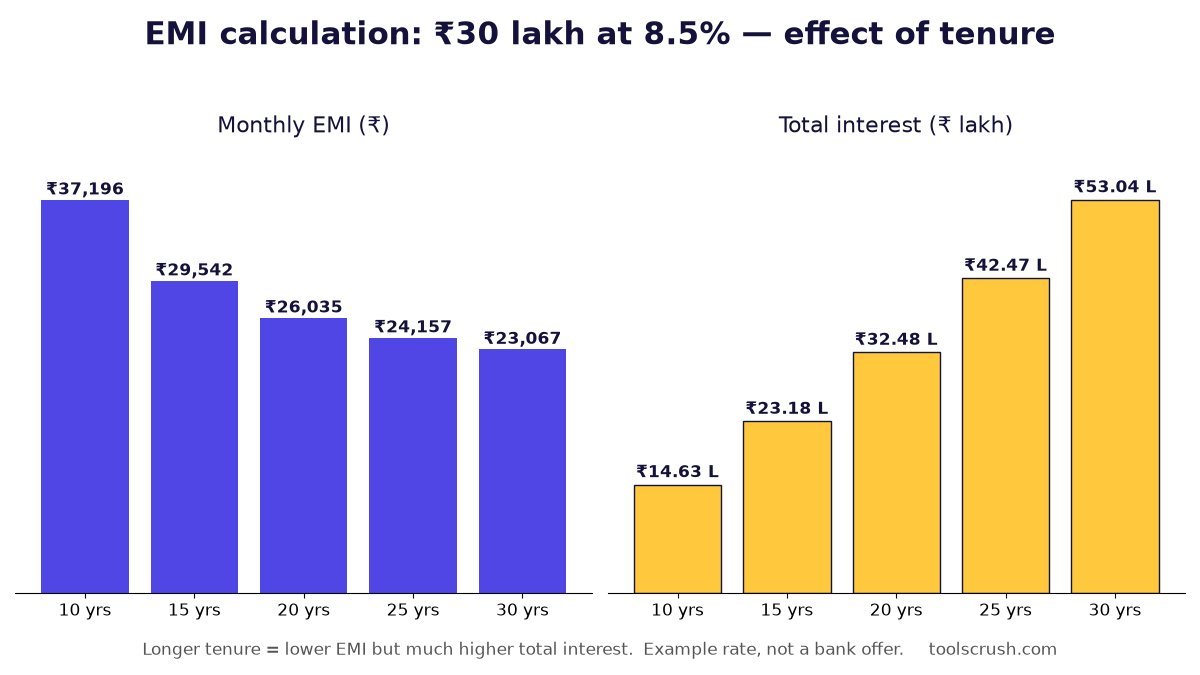
Moving from 20 to 30 years lowers the EMI by only about ₹2,968 a month, yet the total interest jumps by about ₹20.56 lakh. Pick the shortest tenure whose EMI you can pay comfortably. A two-minute EMI calculation for 15, 20 and 25 years makes the choice clear.
Effect of interest rate (tenure fixed at 20 years)
| Interest rate | Monthly EMI | Total interest |
|---|---|---|
| 7.5% | ₹24,168 | ₹28,00,271 |
| 8% | ₹25,093 | ₹30,22,368 |
| 8.5% | ₹26,035 | ₹32,48,327 |
| 9% | ₹26,992 | ₹34,78,027 |
| 9.5% | ₹27,964 | ₹37,11,345 |
| 10% | ₹28,951 | ₹39,48,156 |
Each 0.5% change moves the EMI by roughly ₹900 to ₹1,000 on this loan and the total interest by more than ₹2 lakh. Even a small rate cut from negotiation or a balance transfer is worth chasing, so redo the EMI calculation with each offer you get.
Prepayment savings: reduce EMI or tenure?
Most lenders let you choose what happens after a part-prepayment. Here is the ₹30 lakh home loan example if you prepay ₹2,00,000 after 5 years (after the 60th EMI, when about ₹26,43,815 is still outstanding):
| Option | Monthly EMI after prepayment | Loan ends | Total interest | Interest saved (approx.) |
|---|---|---|---|---|
| No prepayment | ₹26,035 | 240 months | ₹32,48,327 | — |
| Keep EMI, cut tenure | ₹26,035 | 215 months (25 fewer EMIs) | ₹27,94,765 | ₹4,53,562 |
| Keep tenure, cut EMI | ₹24,065 | 240 months | ₹30,93,821 | ₹1,54,506 |
Prepayment tip: if you can comfortably keep paying the same EMI, choosing a shorter tenure usually saves far more interest. Prepaying early in the loan helps the most, because that is when the interest part is largest. Run a fresh EMI calculation for both options before you decide.
On charges, RBI’s Pre-payment Charges on Loans Directions, 2025 say lenders shall not levy pre-payment charges on floating rate loans given to individuals for non-business purposes. These directions apply to loans sanctioned or renewed on or after 1 January 2026. For fixed-rate loans and other cases, check your loan agreement and get the new schedule in writing.
Flat rate vs reducing rate: why EMI calculation differs
Some lenders, especially for consumer durables and some two-wheeler or personal loans, quote a flat rate. A flat rate charges interest on the full original loan for the whole tenure, even though you repay principal every month. A reducing rate charges interest only on the balance you still owe.
| Method | Interest on | Total interest | Monthly EMI |
|---|---|---|---|
| Reducing rate 12% | Outstanding balance | ₹58,715 | ₹9,964.29 |
| Flat rate 12% | Full ₹3,00,000 for 3 years | ₹1,08,000 | ₹11,333.33 |
Both loans are ₹3 lakh for 3 years at a quoted 12%. The flat-rate loan costs about ₹49,285 more. In reducing-rate terms, a 12% flat rate over 3 years works out to about 21.2% a year. Always ask which method the lender uses before you compare offers.
The flat-rate formula is simple: total interest = P × annual rate × years, and EMI = (P + total interest) ÷ n. If a salesperson quotes a low rate and a quick EMI calculation by this method matches their EMI, you are looking at a flat rate.
Floating rates, rate resets and your EMI
If your loan is on a floating rate, the rate can change during the tenure. When it rises, the lender will raise your EMI, extend your tenure, or do both. Here is what a fresh EMI calculation shows if the rate rises by 0.5% after 2 years for the ₹30 lakh loan (balance about ₹28,75,309, 216 months left):
- Keep the tenure, raise the EMI: the EMI goes up by about ₹891, from ₹26,035 to about ₹26,926.
- Keep the EMI, extend the tenure: about 20 more EMIs are needed, so the loan runs for about 260 months instead of 240.
RBI’s circular on reset of floating interest rate on EMI-based personal loans asks lenders to explain at sanction how a benchmark rate change can affect your EMI, tenure or both. It also asks them to inform you immediately of any increase and to share a quarterly statement with principal and interest recovered, EMI amount, EMIs left and the annualised rate or APR.
The same circular says borrowers should get a choice between a higher EMI, a longer tenure or a mix of both, and the option to prepay in part or in full at any time. Under the update effective 1 October 2025, offering a switch to a fixed rate at reset is at the lender’s option, as per its Board-approved policy.
Before you sign, also read the Key Facts Statement. RBI’s Key Facts Statement (KFS) circular requires lenders to give retail and MSME term loan borrowers a KFS with the Annual Percentage Rate (APR) and the full repayment schedule. The APR includes the interest rate and all other charges, so it is a better number to compare than the interest rate alone.
EMI calculation in Excel or Google Sheets
If you prefer spreadsheets, EMI calculation takes one built-in function, so you do not need to type the full formula. Use PMT:
- Formula: =PMT(rate/12, months, -loan)
- ₹1 lakh, 12%, 12 months: =PMT(12%/12, 12, -100000) gives 8,884.88.
- ₹30 lakh, 8.5%, 20 years: =PMT(8.5%/12, 240, -3000000) gives 26,034.70.
- Interest in a given month: =IPMT(rate/12, month, months, -loan).
- Principal in a given month: =PPMT(rate/12, month, months, -loan).
The minus sign before the loan amount simply makes the answer positive. With IPMT and PPMT you can build your own amortization table in a few minutes and check it against your bank’s schedule.
Reverse EMI calculation: how much loan can you afford?
Sometimes you know the EMI you can pay and want the loan amount. Reverse EMI calculation simply turns the formula around:
Loan amount P = EMI × ((1 + r)n − 1) ÷ (r × (1 + r)n)
Example: if you can pay ₹25,000 a month for 20 years at 8.5%, r = 0.0070833 and n = 240. The formula gives a maximum loan of about ₹28,80,771. Remember to keep room in your budget for rate rises, insurance and emergencies, not just the EMI.
Lenders also look at your income, existing EMIs and credit score before deciding how much to lend. Treat this number as your own comfort limit, not the bank’s approval figure.
Common EMI calculation mistakes to avoid
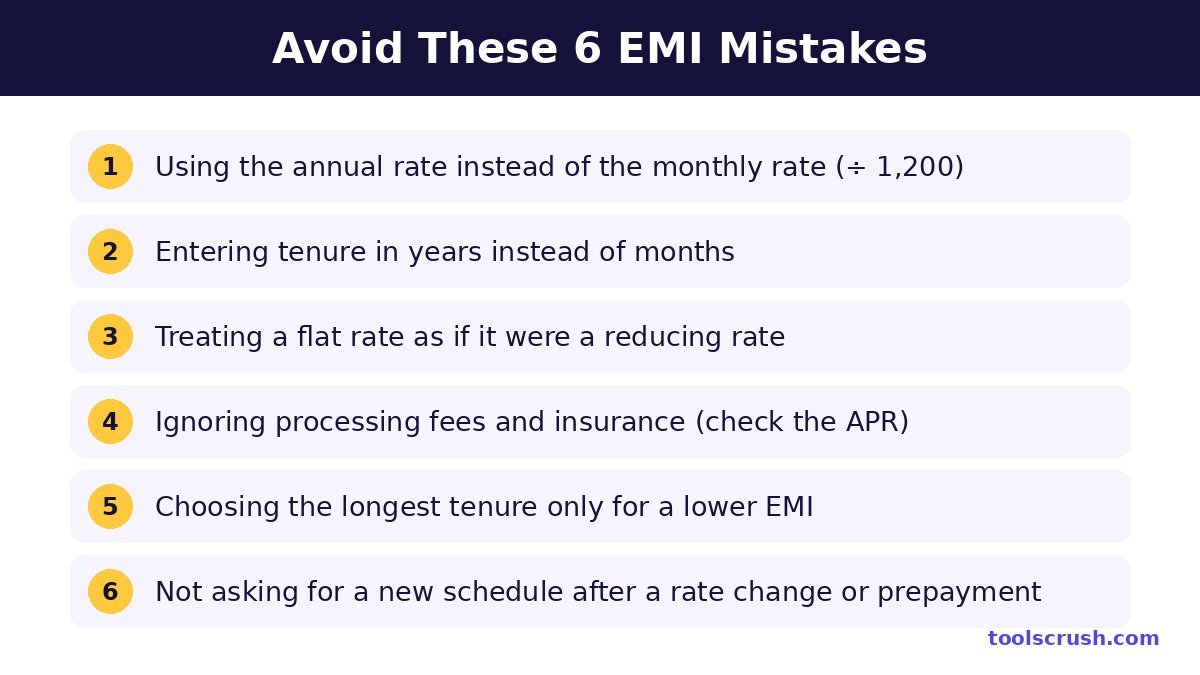
- Using the annual rate as r. If you put 12 or 0.12 into the formula instead of 0.01, the answer will be wildly wrong. Always divide the annual rate by 1,200.
- Entering years instead of months. A 5-year loan has n = 60, not 5.
- Confusing flat and reducing rates. A flat 12% is far costlier than a reducing 12%, as the table above shows.
- Ignoring fees. Processing fees, insurance and other charges raise the real cost. Compare the APR in the KFS.
- Picking the longest tenure by default. A slightly lower EMI can cost lakhs in extra interest.
- Not updating after changes. After a rate reset or prepayment, ask the lender for a fresh amortization schedule.
A quick EMI calculation check against the free calculator before you sign avoids almost all of these.
EMI glossary: key loan terms in simple words
These terms come up again and again in EMI calculation and in loan documents.
- Principal: the amount you borrow, or the part of it still unpaid.
- Tenure: the total repayment period, usually stated in months or years.
- Reducing balance: interest is charged only on the amount still owed.
- Flat rate: interest is charged on the original loan amount for the whole tenure.
- Floating rate: a rate linked to a benchmark that can change during the loan.
- APR: Annual Percentage Rate, the yearly cost of credit including interest and other charges.
- KFS: Key Facts Statement, a standard summary of the loan terms given before you sign.
- Amortization schedule: the month-by-month table of interest, principal and balance.
- Part-prepayment: paying extra towards principal before it is due.
Key takeaways
- The EMI calculation formula is EMI = P × r × (1 + r)n ÷ ((1 + r)n − 1), with r as the monthly rate and n in months.
- ₹1,00,000 at 12% for 12 months = ₹8,884.88 EMI and about ₹6,619 interest.
- Early EMIs are mostly interest; later EMIs are mostly principal.
- A longer tenure lowers the EMI but sharply increases total interest.
- Prepaying and keeping the same EMI usually saves the most interest.
- A flat rate costs much more than the same reducing rate. Compare the APR in the KFS.
- Check any loan offer in seconds with the ToolsCrush EMI Calculator.
Related free tools: buying something with GST on top? Use our GST Calculator. Need a due date or the gap between two EMI dates? Read how many days between two dates, see what date is 30 days from today, or use the Date Calculator. You can find more in our guide to free online tools.
Frequently asked questions
What is the formula for EMI calculation?
EMI = P × r × (1 + r)^n ÷ ((1 + r)^n − 1). P is the loan amount, r is the monthly interest rate (annual rate ÷ 12 ÷ 100) and n is the number of months.
What is the EMI for a ₹1 lakh loan at 12% for 1 year?
The EMI is ₹8,884.88 per month. You pay about ₹1,06,619 in total, so the interest is about ₹6,619.
Is EMI interest calculated on the full loan amount?
No. In a standard reducing-balance loan, interest is charged each month only on the amount still outstanding. That is why the interest part of your EMI falls over time. Only flat-rate loans charge interest on the full original amount.
Is it better to reduce EMI or tenure after prepayment?
Reducing tenure usually saves more interest. In our ₹30 lakh, 8.5%, 20-year example, a ₹2 lakh prepayment after 5 years saves about ₹4.54 lakh by cutting tenure, compared with about ₹1.55 lakh by cutting the EMI.
How do I do EMI calculation in Excel?
Use =PMT(rate/12, months, -loan). For example, =PMT(8.5%/12, 240, -3000000) gives an EMI of 26,034.70 for a ₹30 lakh loan at 8.5% for 20 years.
What happens to my EMI when a floating rate goes up?
The lender can raise the EMI, extend the tenure, or both. RBI asks lenders to tell you about the impact at sanction, inform you of any increase immediately and give you a choice between a higher EMI, a longer tenure or a mix.
Why is my bank’s EMI slightly different from my calculation?
Lenders may round differently, count days differently, or add processing fees and insurance. Ask the lender for the loan’s amortization schedule and Key Facts Statement to see the exact numbers.
Is the ToolsCrush EMI Calculator free?
Yes. It is free, needs no sign-up and works for home, car, personal and education loans.
The rates used in this article are examples for illustration only, not offers or current bank rates. Always confirm the final EMI calculation with your lender.