
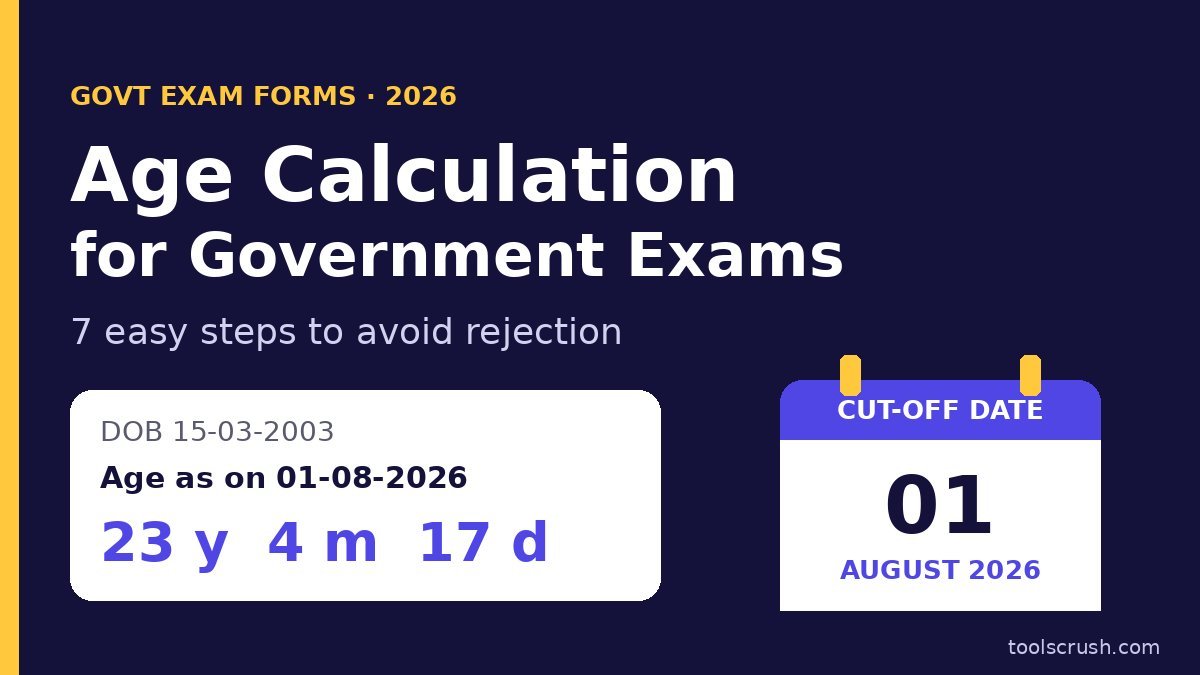
Age calculation for a government exam means finding your completed years, months and days between your date of birth and the cut-off date printed in the notification, not today’s date. Example: born 15-03-2003, your age as on 01-08-2026 is 23 years, 4 months, 17 days. Then check that your date of birth falls inside the “born not before / not later than” dates.
Last updated: October 2026
Check your exact age in seconds: use the free ToolsCrush Age Calculator. Enter your date of birth, change the “as on” date to the cut-off date from your exam notification, and it shows your age in years, months and days. It runs in your browser and needs no sign-up.
Many candidates filling SSC, UPSC, railway, bank and state exam forms get stuck on one line: “Age as on 01-08-2026”. A wrong age calculation, even by a single day, can make a form invalid and lead to rejection at document verification. This age calculation guide shows the full method, borderline birthdays, category relaxation and the documents you need.
What does “age as on cut-off date” mean?
The cut-off date (also called the crucial date or the date of reckoning) is the single date on which the recruiting body checks your age. It does not matter how old you are on the day you apply or on the exam day. Only your age on the cut-off date counts, so every age calculation starts from that date.
So the first rule of age calculation is simple: forget today’s date. A candidate who is 27 today may still be 26 on the cut-off date, and a candidate who is 17 today may be 18 by then. The notification decides the date, and you work backwards from it.
Why is the cut-off date usually 1 January or 1 August?
For central government recruitment through UPSC and SSC, the Department of Personnel and Training (DoPT) has a standard rule: the crucial date is 1 January of the exam year if the exam is held in the first half of the year, and 1 August if it is held in the second half. You can read this in the DoPT Office Memorandum on relaxation of upper age limit (para 16). The exact date is always printed in the notification, so treat that printed date as final. State commissions, banks and other recruiters can use different dates.
What if the exam is held in two parts or gets shifted?
The same DoPT compilation says that when an exam is held in two parts on two different dates, the later date is used. It also says that if an exam normally held in the first half of the year is shifted to the second half, the crucial date stays 1 January. In real life you do not need to work this out yourself: just read the “Age limit (as on …)” line in your notification and use that date for your age calculation.
Age calculation formula for government exams
Every age calculation for an exam form uses the same idea: subtract your date of birth from the cut-off date, one unit at a time, and borrow from the bigger unit when a result becomes negative.
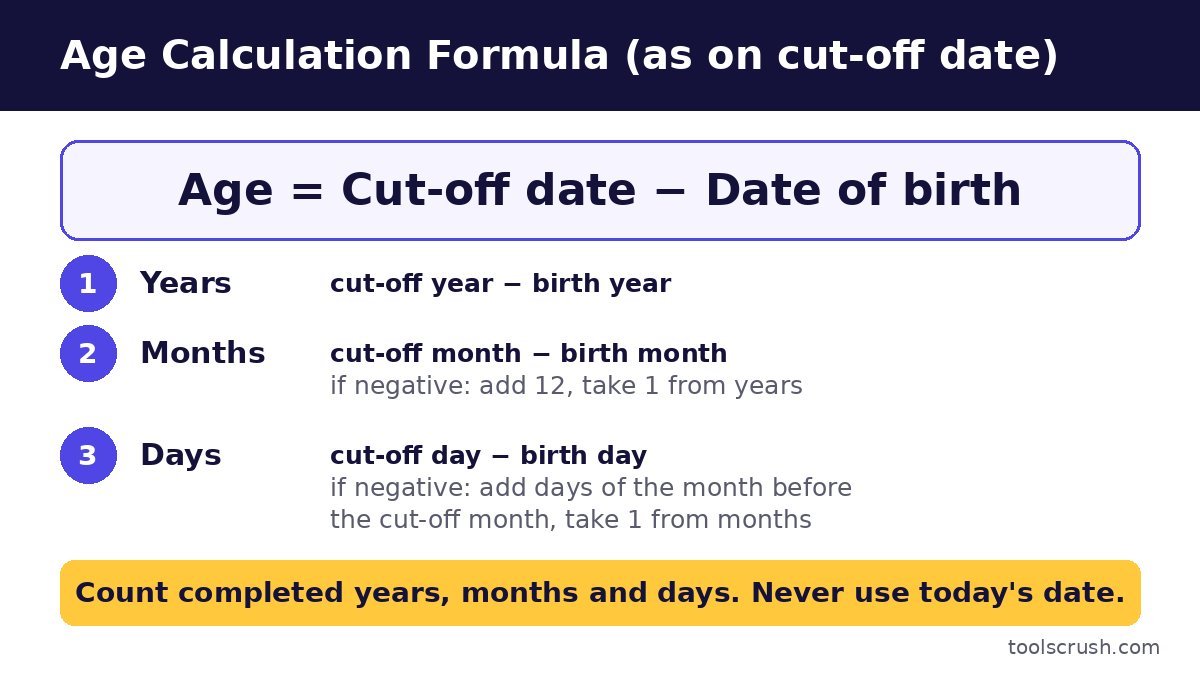
- Years = cut-off year − birth year.
- Months = cut-off month − birth month. If negative, add 12 and take 1 from years.
- Days = cut-off day − birth day. If negative, add the number of days in the month before the cut-off month and take 1 from months.
Why the month before the cut-off month? Because you are “borrowing” the last full month that ended before the cut-off day. For a 1 August cut-off, that month is July, which has 31 days. For a 1 January cut-off, it is December, which also has 31 days. This is the age calculation method followed by most online calculators, including ours.
Age calculation in 7 easy steps
Follow these seven steps in order. This age calculation takes about two minutes with a pen and paper, and they cover the checks that most rejected forms miss.
- Find the cut-off date in the official notification, under “Age limit (as on …)”.
- Note the birth-date range printed next to it, for example “born not before 02-08-1999 and not later than 01-08-2008”.
- Write your date of birth exactly as on your Class 10 certificate, in DD-MM-YYYY format.
- Subtract the years: cut-off year − birth year.
- Subtract the months: cut-off month − birth month. If the result is negative, take away 1 year and add 12 months.
- Subtract the days: cut-off day − birth day. If the result is negative, take away 1 month and add the days of the month before the cut-off month.
- Compare and apply relaxation: check the result against the age limit, add any category relaxation to the upper limit only, and confirm your date of birth sits inside the printed range.
Step 7 is the one that saves forms. Your age calculation gives you a number, but the printed dates are the final test. If you want to skip the arithmetic, the free Age Calculator does steps 4 to 6 for you.
Worked examples of age calculation
Here is the age calculation method on real dates. Each example shows every borrow, so you can follow the same pattern for your own birthday.
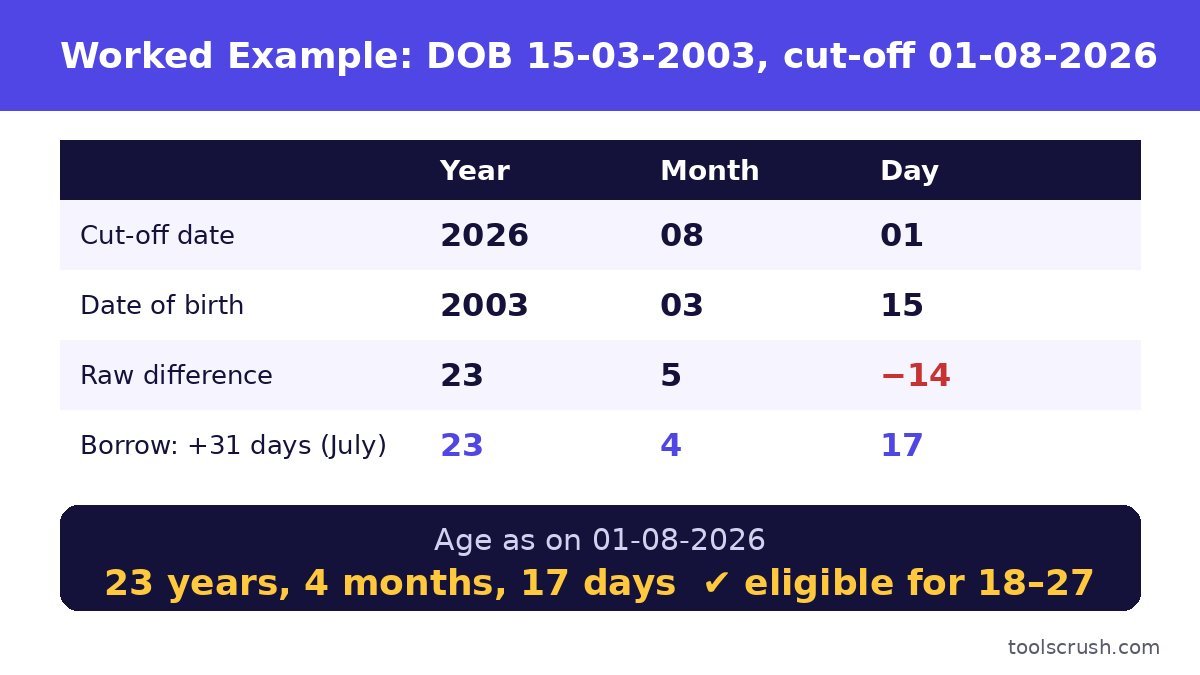
Example 1: a 1 August cut-off (DOB 15-03-2003)
Date of birth: 15-03-2003. Cut-off date: 01-08-2026.
- Years: 2026 − 2003 = 23
- Months: 8 − 3 = 5
- Days: 1 − 15 = −14, which is negative. So take 1 month away (5 becomes 4) and add the 31 days of July: −14 + 31 = 17
- Age as on 01-08-2026 = 23 years, 4 months, 17 days
Example 2: a 1 January cut-off (DOB 20-01-2001)
Date of birth: 20-01-2001. Cut-off date: 01-01-2026.
- Years: 2026 − 2001 = 25. Months: 1 − 1 = 0. Days: 1 − 20 = −19.
- Days are negative, so borrow a month: months become −1, and days become −19 + 31 (December) = 12.
- Months are now negative, so borrow a year: years become 24, months become 11.
- Age as on 01-01-2026 = 24 years, 11 months, 12 days
Notice the double borrow. This is where most manual age calculation goes wrong, because people stop after fixing the days and forget that the months also went negative.
Example 3: a leap-year birthday (DOB 29-02-2004)
Date of birth: 29-02-2004. Cut-off date: 01-08-2026.
- Years: 2026 − 2004 = 22. Months: 8 − 2 = 6. Days: 1 − 29 = −28.
- Borrow a month: months become 5, days become −28 + 31 (July) = 3.
- Age as on 01-08-2026 = 22 years, 5 months, 3 days
A 29 February birthday does not need any special age calculation rule for exam forms. You use the date exactly as printed on your certificate and follow the same steps.
Borderline birthdays: one-day age calculation traps
Most age calculation rejections happen at the edges, when a birthday falls on or right next to the cut-off date. The SSC CHSL Examination 2026 notice is a good example. It says the age limit is 18–27 years as on 01-08-2026, which means candidates born not before 02-08-1999 and not later than 01-08-2008 can apply.
Turning 18 on the cut-off date
A candidate born on 01-08-2008 is exactly 18 years, 0 months, 0 days on 01-08-2026, and 01-08-2008 is the last date allowed, so this candidate is eligible. A candidate born one day later, on 02-08-2008, is 17 years, 11 months, 30 days and is not eligible. One day decides the whole age calculation.
Turning 27 on the cut-off date
At the upper end the trap is the opposite. A candidate born on 01-08-1999 is exactly 27 years, 0 months, 0 days on the cut-off date. Many people read “18–27” and assume 27 is allowed, but the notice only allows births from 02-08-1999 onwards. So this candidate is outside the range, while someone born on 02-08-1999 (26 years, 11 months, 30 days) is inside it.
| Date of birth | Age as on 01-08-2026 | Inside “born not before 02-08-1999 and not later than 01-08-2008”? |
|---|---|---|
| 02-08-2008 | 17 years, 11 months, 30 days | No (one day too young) |
| 01-08-2008 | 18 years, 0 months, 0 days | Yes (last eligible date) |
| 31-07-2008 | 18 years, 0 months, 1 day | Yes |
| 15-03-2003 | 23 years, 4 months, 17 days | Yes |
| 02-08-1999 | 26 years, 11 months, 30 days | Yes (first eligible date) |
| 01-08-1999 | 27 years, 0 months, 0 days | No (one day too early) |
| 30-07-1999 | 27 years, 0 months, 2 days | No |
The lesson: when your age calculation lands within a day or two of the limit, stop looking at the age and look at the printed birth dates. They are the final word.
Date-of-birth range tables for a 01-08-2026 cut-off
If you prefer to skip age calculation altogether, you can turn any age limit into a birth-date range and simply check whether your date of birth falls inside it. The table below uses the same pattern as SSC’s 2026 notices.
Common age limits as on 01-08-2026
| Age limit | Born not before | Born not later than |
|---|---|---|
| 18–27 years | 02-08-1999 | 01-08-2008 |
| 18–30 years | 02-08-1996 | 01-08-2008 |
| 20–30 years | 02-08-1996 | 01-08-2006 |
| 18–32 years | 02-08-1993 | 01-08-2008 |
The 18–27 range matches the SSC CHSL 2026 notice. The other rows follow the same pattern and match the ranges printed in SSC’s other 2026 notices for those limits, but always confirm against the notice for your post.
How to turn any age limit into birth dates
- Youngest allowed (lower limit L): born not later than the cut-off date minus L years. For L = 18 and a 01-08-2026 cut-off, that is 01-08-2008.
- Oldest allowed (upper limit U): born not before the day after the cut-off date, minus (U + 1) years. For U = 27, that is 02-08-1999.
- With relaxation: add the relaxation years to U first, then use the same rule. OBC with U = 27 + 3 = 30 gives 02-08-1996.
Counting dates by hand during age calculation can be slow. For age calculation with long gaps, our guide on how many days between two dates explains how to count exact gaps, and the Date Calculator lets you add or subtract years from any date.
Age relaxation by category (SC, ST, OBC, PwBD, ESM)
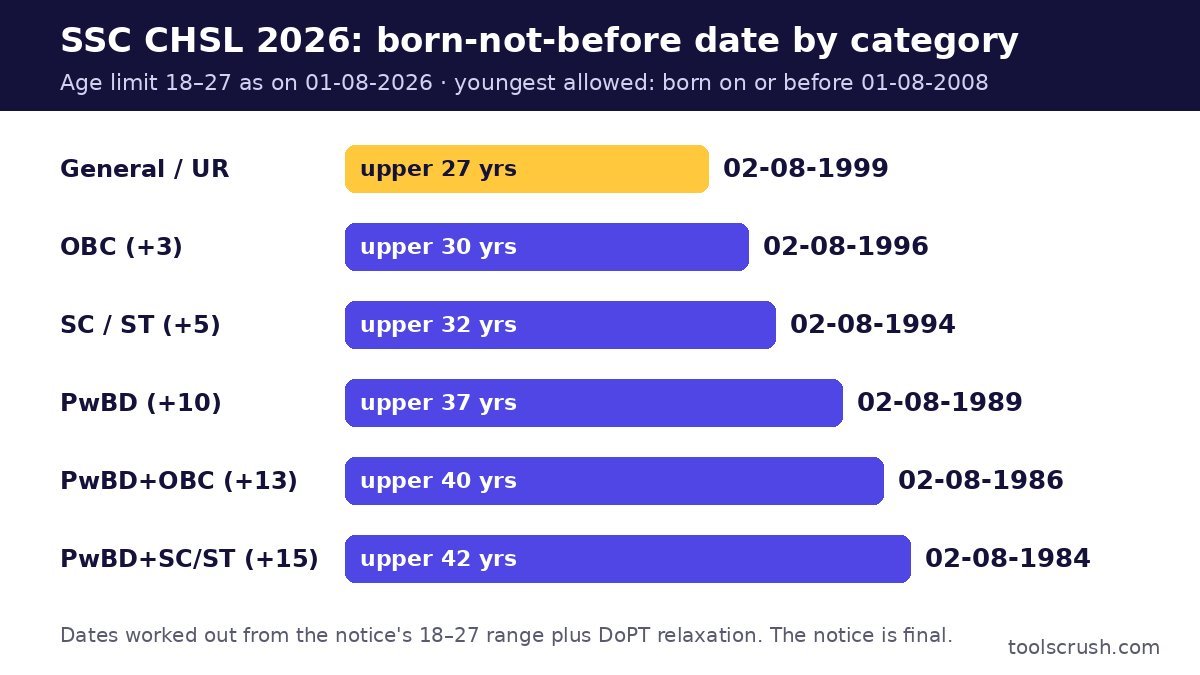
For direct recruitment to central government civil posts, DoPT rules allow extra years beyond the upper age limit for certain categories. The SSC CHSL 2026 notice lists the same values. The table shows what they mean for a general upper limit of 27 years and a 01-08-2026 cut-off.
| Category | Relaxation in upper age limit | Upper limit if general limit is 27 | Born not before (01-08-2026 cut-off) |
|---|---|---|---|
| General / Unreserved | None | 27 years | 02-08-1999 |
| OBC | 3 years | 30 years | 02-08-1996 |
| SC / ST | 5 years | 32 years | 02-08-1994 |
| PwBD (Unreserved) | 10 years | 37 years | 02-08-1989 |
| PwBD + OBC | 13 years | 40 years | 02-08-1986 |
| PwBD + SC / ST | 15 years | 42 years | 02-08-1984 |
| Ex-Servicemen | 3 years after deducting military service from actual age | Depends on service length | Work out case by case |
Conditions to remember
- Relaxation raises only the upper age limit. It never lowers the minimum age.
- PwBD relaxation needs at least 40% benchmark disability, and the post must be identified as suitable for that disability. DoPT also caps the maximum age for PwBD candidates at 56 years on the crucial date.
- You need a valid category certificate in the format the notification asks for. SSC says the crucial date for claiming category status is the closing date of the application.
- Relaxation is not admissible to sons, daughters and dependents of ex-servicemen, as the SSC CHSL 2026 notice states.
- Relaxations for state government jobs are set by each state and may differ from central rules.
Age calculation with relaxation: worked examples
These examples use the SSC CHSL 2026 pattern (18–27 years as on 01-08-2026). In each case, do the normal age calculation first, then compare with the relaxed limit.
OBC example (DOB 10-09-1996)
- Age as on 01-08-2026 = 29 years, 10 months, 22 days.
- As a General candidate: above 27, so not eligible.
- As an OBC candidate: upper limit becomes 30, which means “born not before 02-08-1996”. 10-09-1996 is after that date, so eligible.
SC/ST example (DOB 20-03-1995)
- Age as on 01-08-2026 = 31 years, 4 months, 12 days.
- OBC limit of 30 (born not before 02-08-1996): not eligible as OBC.
- SC/ST limit of 32 (born not before 02-08-1994): 20-03-1995 is after that date, so eligible as SC/ST.
PwBD examples
PwBD (Unreserved), DOB 15-06-1990: age as on 01-08-2026 is 36 years, 1 month, 17 days by the usual age calculation. The PwBD upper limit is 27 + 10 = 37 years (born not before 02-08-1989), so this candidate is eligible, provided the disability is at least 40% and the post suits it.
PwBD + SC/ST, DOB 12-04-1985: age as on 01-08-2026 is 41 years, 3 months, 20 days. A PwBD (Unreserved) candidate of this age would be over the 37-year limit. With PwBD + SC/ST relaxation of 15 years, the limit is 42 years (born not before 02-08-1984), so this candidate is eligible.
Ex-servicemen examples
For ex-servicemen, SSC CHSL 2026 allows 3 years after deducting the military service rendered from the actual age as on 01-08-2026. So you first do the age calculation, then subtract your exact service period, and check whether the result is within 27 + 3 = 30 years.
- DOB 20-11-1988, military service 9 years 6 months: age as on 01-08-2026 = 37 years, 8 months, 12 days. After deducting service: 28 years, 2 months, 12 days. That is within 30, so eligible.
- DOB 12-04-1985, military service 10 years: age as on 01-08-2026 = 41 years, 3 months, 20 days. After deducting service: 31 years, 3 months, 20 days. That is above 30, so not eligible under the ESM relaxation.
Use the exact service dates from your discharge book or service certificate. A rough “about ten years” can flip the age calculation result at the edge.
Other categories in the SSC CHSL 2026 notice
- Central government civilian employees with at least 3 years of regular and continuous service: up to 40 years of age (45 for SC/ST).
- Widows, divorced women and women judicially separated who have not remarried: up to 35 years of age (40 for SC/ST).
- Defence personnel disabled in operations during hostilities and released as a result: 3 years (8 for SC/ST).
Common age calculation mistakes to avoid
- Using today’s date. Your age today is not your age on the cut-off date, so an age calculation based on today is wrong.
- Mixing up date formats. 05-08-2003 is 5 August in DD-MM-YYYY but 8 May in MM-DD-YYYY. Indian forms use DD-MM-YYYY, while some phone apps show MM-DD.
- Forgetting the double borrow. When days go negative and you borrow a month, check whether the months are now negative too.
- Borrowing the wrong month length. Add the days of the month before the cut-off month, not your birth month.
- Counting days inclusive by mistake. Age is counted in completed years, months and days. Do not count both your birth day and the cut-off day.
- Using the wrong date of birth. Use the date in your Class 10 (matriculation) certificate, not an Aadhaar card or a family record.
- Applying relaxation to the lower limit. Category relaxation raises the upper age limit only.
- Trusting the age number over the printed dates. At the edges, the “born not before / not later than” dates decide.
If you are not sure about your own working, do the age calculation twice: once by hand and once with an online calculator. If both age calculation results match, you are safe.
Documents accepted as date-of-birth proof
Your age calculation is only as good as the date of birth you start with, and recruiters are strict about which document that date comes from. A perfect age calculation on the wrong date of birth still fails verification.
- SSC: the CHSL 2026 notice says the date of birth filled in the online form and recorded in the Matriculation/Secondary Examination Certificate will be accepted, and no later request for change will be considered.
- UPSC: the UPSC Civil Services Examination 2026 notice accepts the date in the Matriculation or Secondary School Leaving Certificate or an equivalent certificate, and clearly says that horoscopes, affidavits, birth extracts from a Municipal Corporation, service records and the like will not be accepted.
- Other recruiters: railways, banks and state commissions publish their own rules, but most also rely on the Class 10 certificate. Check the “documents” section of your notification.
If your Class 10 certificate shows a different date from your Aadhaar or birth certificate, fill the form with the Class 10 date, because that is what will be verified during your age calculation check. Then get your other documents ready too. Our guide to resize photo and signature for exam forms shows how to meet KB and pixel limits, and the RRB NTPC photo and signature size guide covers railway forms.
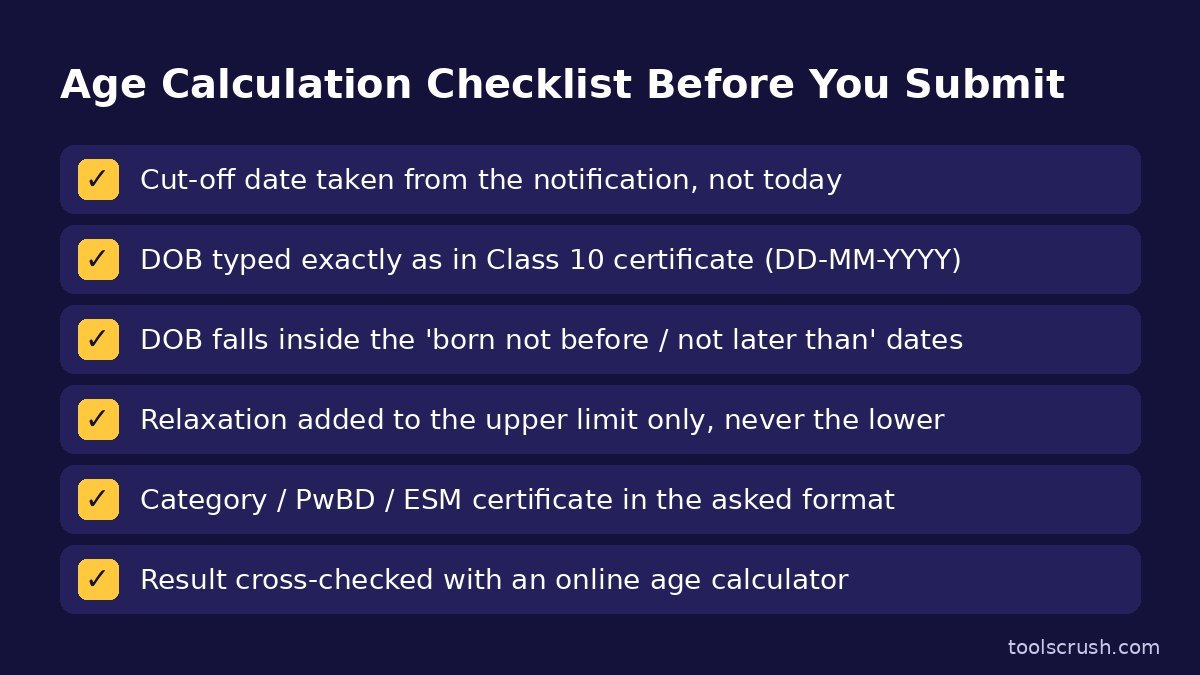
Free tools that make exam forms easier
- Age Calculator: set the “as on” date to your cut-off date for an instant age calculation.
- Date Calculator: add or subtract days, months or years from any date.
- What date is 30 days from today: handy for tracking last dates and correction windows.
- Days between two dates: count the exact gap between any two dates.
Before applying, always visit the official Staff Selection Commission website or your recruiter’s site to download the latest notice. A blog guide to age calculation, including this one, is only a helper.
Key takeaways
- Your eligible age is your age on the cut-off date in the notification, not today.
- For UPSC and SSC, the cut-off is usually 1 January (first-half exams) or 1 August (second-half exams) under DoPT rules.
- Age calculation means completed years, months and days, borrowing a month or a year when a result is negative.
- The “born not before / not later than” dates decide eligibility, especially at the one-day edges.
- Common central relaxations: OBC 3 years, SC/ST 5 years, PwBD 10 years (13 for OBC, 15 for SC/ST); ESM 3 years after deducting service.
- Use the date of birth in your Class 10 certificate, and cross-check with the ToolsCrush Age Calculator.
Frequently asked questions
How do I calculate my age as on a specific date?
Subtract your date of birth from the specific date: years first, then months, then days. If days or months come out negative, borrow from the next larger unit. The ToolsCrush Age Calculator does this automatically when you set the “as on” date.
What is the cut-off date for age calculation in SSC and UPSC exams?
Under DoPT rules it is usually 1 January of the exam year for exams held in the first half of the year, and 1 August for exams held in the second half. The notification always states the exact date.
If my age is exactly 27 on the cut-off date, am I eligible for an 18–27 age limit?
Not always. Check the birth-date range in the notification. For example, the SSC CHSL 2026 notice allows candidates born not before 02-08-1999, so someone born on 01-08-1999, who is exactly 27 on 01-08-2026, is outside the range.
Am I eligible if I turn 18 on the cut-off date?
For SSC CHSL 2026, yes. The last allowed birth date is 01-08-2008, so a candidate who turns exactly 18 on 01-08-2026 is eligible. Someone born on 02-08-2008 is one day too young.
How many years of age relaxation do OBC, SC and ST candidates get?
For central government direct recruitment, OBC candidates generally get 3 years and SC/ST candidates get 5 years in the upper age limit. Always confirm in the official notification.
How much age relaxation do PwBD candidates get?
For central government posts, PwBD candidates generally get 10 years, which becomes 13 years for OBC and 15 years for SC/ST, subject to at least 40% disability and the post being suitable for that disability.
How is age calculated for ex-servicemen?
For SSC CHSL 2026, do the age calculation as on 01-08-2026, then subtract your actual military service from that age. If the result is not more than 3 years above the upper age limit, you meet the age condition.
Which date of birth should I use in the age calculator?
Use the date of birth in your Class 10 (matriculation) certificate. SSC, for example, determines age only from the date recorded in that certificate.
Sources: DoPT Office Memorandum dated 6 September 2022 on relaxation of upper age limit for direct recruitment to central civil services and posts; SSC CHSL Examination 2026 notice; UPSC CSE 2026 notice. This article is general guidance; the official notification for your exam is final.