
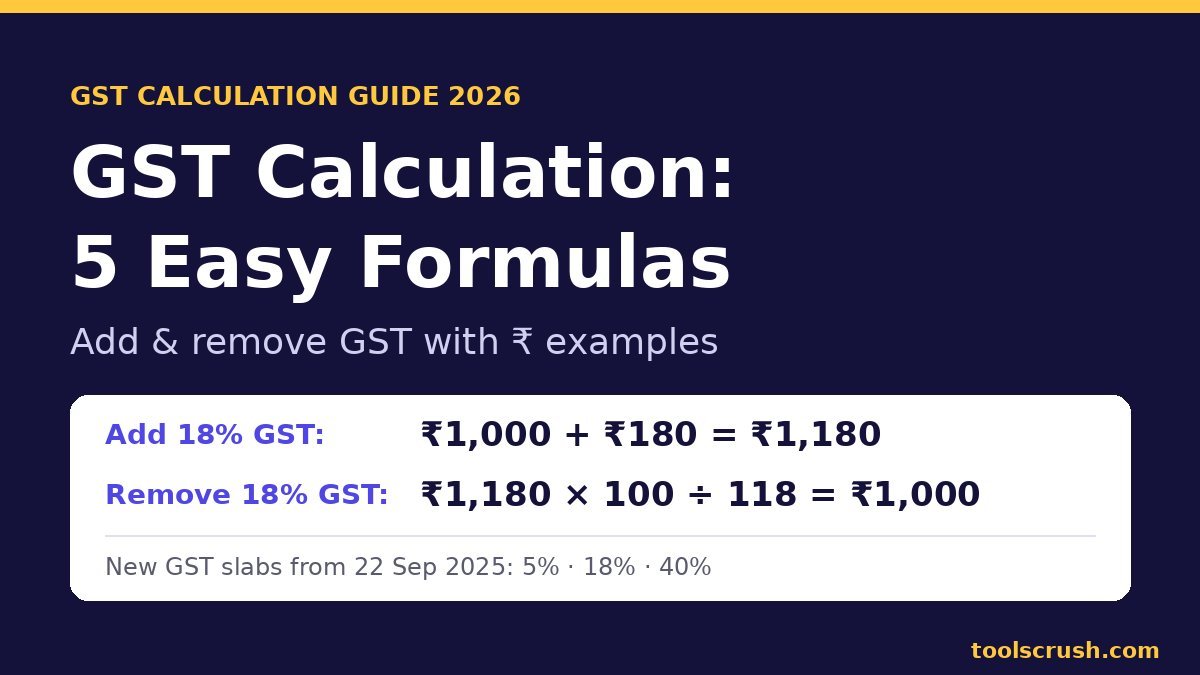
GST calculation is simple once you know two formulas: to add GST, GST = Price × Rate ÷ 100; to remove GST from an inclusive price, Base Price = Total × 100 ÷ (100 + Rate). Example: ₹1,000 + 18% GST = ₹1,180, and a ₹1,180 inclusive price = ₹1,000 base + ₹180 GST.
Last updated: October 2026
Want the answer in two seconds? Use the free ToolsCrush GST Calculator. Enter the amount, pick the rate, and choose “Add GST” or “Remove GST”. It shows the base price, the GST amount and the total. There is nothing to sign up for.
This guide is for shop owners making bills, freelancers sending invoices, students learning commerce and anyone checking whether a bill is correct. We use simple English, the current GST slabs and real ₹ examples, so your GST calculation is right the first time.
What is GST calculation?
GST (Goods and Services Tax) is the tax added to the price of most goods and services sold in India. GST calculation means working out three numbers on any bill: the base price (also called the taxable value), the GST amount, and the final price the customer pays.
You only need to know two things before you start any GST calculation. First, the GST rate for the item, which depends on its HSN code (for goods) or SAC code (for services). Second, whether the price you have is exclusive (tax not yet added) or inclusive (tax already inside). Every GST calculation in this guide starts from those two facts.
The words used on bills can be confusing at first, so here are the GST calculation terms in one place:
- Base price / taxable value: the price before GST.
- GST rate: the percentage, such as 5% or 18%.
- GST amount: the tax in rupees.
- Total / inclusive price: base price plus GST. The MRP printed on a pack is an inclusive price.
What are the current GST rates in India (2026)?
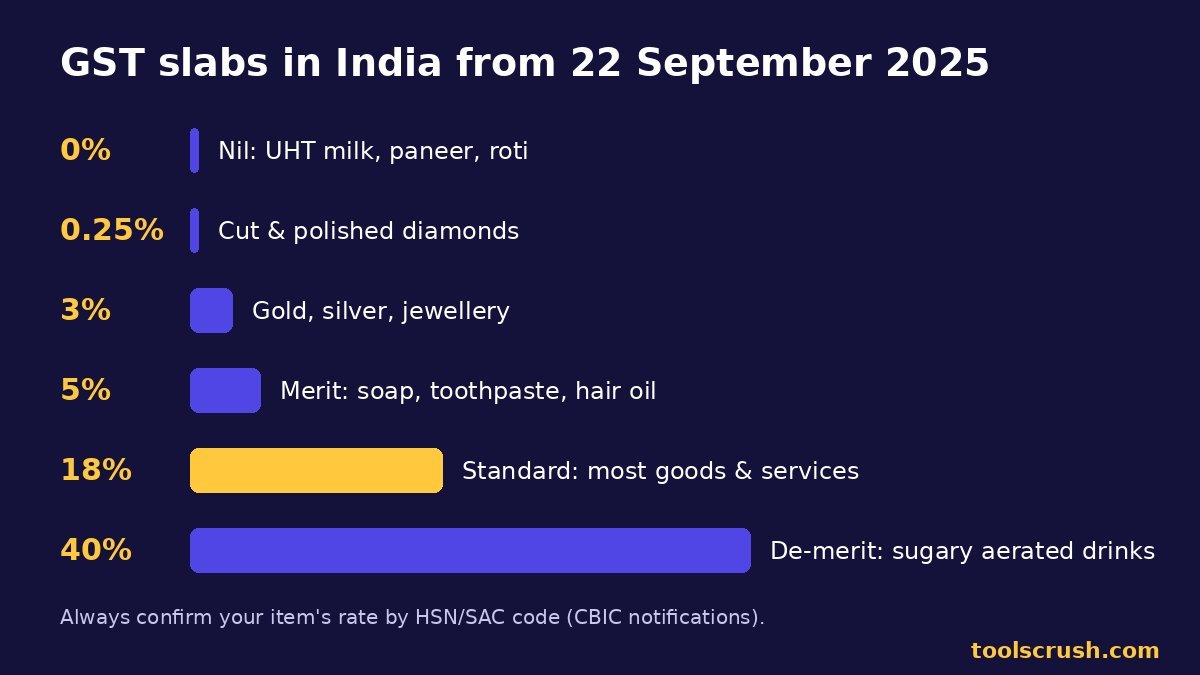
The GST Council, in its 56th meeting on 3 September 2025, replaced the old four-slab system (5%, 12%, 18%, 28%) with a simpler structure: a standard rate of 18%, a merit rate of 5%, and a special de-merit rate of 40% for a select few goods and services. Every GST calculation you do today should use these rates. You can read the full decision in the PIB press release on the 56th GST Council meeting.
The new rates came into effect from 22 September 2025. Pan masala, gutkha, cigarettes, chewing tobacco such as zarda, unmanufactured tobacco and bidi were kept on a separate timeline, to be notified later.
| GST rate | What it is called | Typical examples |
|---|---|---|
| 0% (Nil / exempt) | Exempt | UHT milk, pre-packaged and labelled paneer, Indian breads like roti and paratha |
| 0.25% | Special rate | Cut and polished diamonds and precious stones |
| 3% | Special rate | Gold, silver and jewellery |
| 5% | Merit rate | Hair oil, toilet soap bars, toothpaste, many packaged foods |
| 18% | Standard rate | Most goods and most services |
| 40% | Special de-merit rate | Selected luxury and “sin” goods, such as sugary aerated drinks |
What changed for common items?
These are some of the changes listed in the official release. They matter for GST calculation because old price lists may still show the old rate:
- Hair oil, toilet soap bars, shampoo, toothpaste, toothbrushes and bicycles: down to 5% (from 12% or 18%).
- Packaged namkeen, bhujia, sauces, pasta, instant noodles, chocolates, coffee, butter and ghee: down to 5% (from 12% or 18%).
- UHT milk, pre-packaged paneer and Indian breads such as roti and paratha: down to nil (from 5% or 18%).
- Air conditioners, TVs, dishwashers, small cars, motorcycles up to 350 cc and cement: down to 18% (from 28%).
- Sugary or flavoured aerated drinks: up to 40% (from 28%).
Important: the rate depends on the exact HSN or SAC code of your product or service. Always confirm the rate for your item in the official rate notifications on the CBIC GST portal or with your tax advisor before you bill.
5 easy GST calculation formulas you need
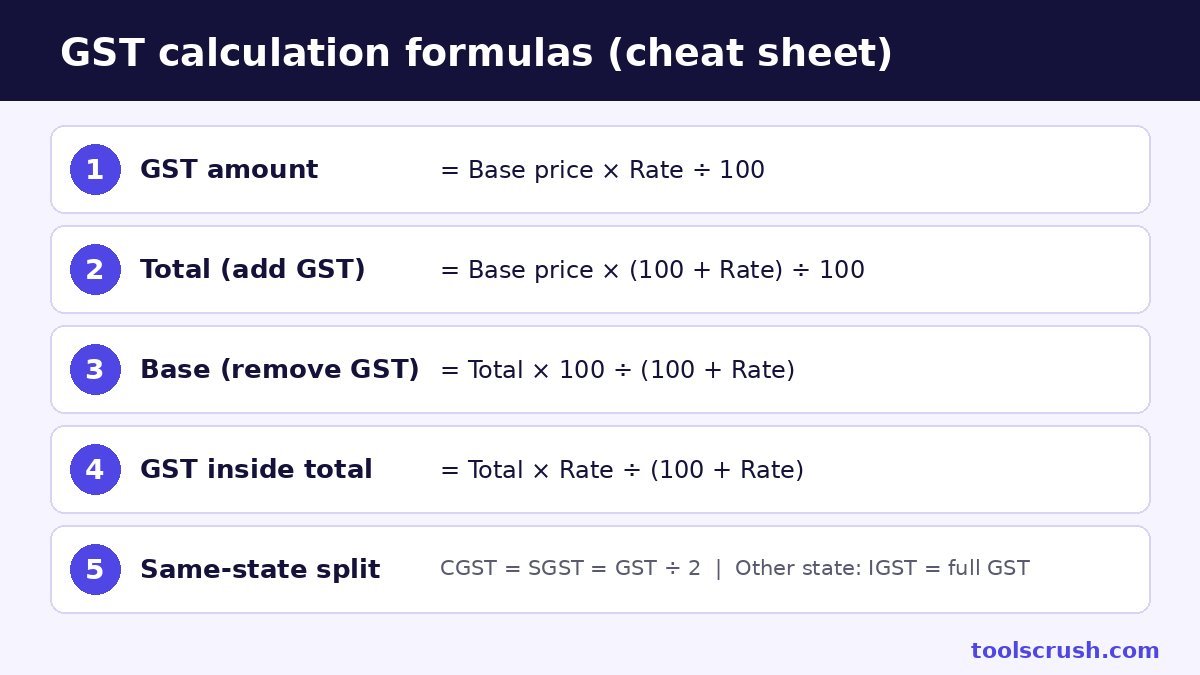
Almost every GST calculation can be done with one of these five formulas. Save the cheat sheet below or bookmark this page.
Formula 1: GST amount on a base price
GST Amount = Base Price × GST Rate ÷ 100. This is the most common GST calculation, used when you know the price before tax. Example: ₹2,500 at 5% gives ₹2,500 × 5 ÷ 100 = ₹125 GST.
Formula 2: Total price after adding GST
Total = Base Price × (100 + Rate) ÷ 100. This does the whole GST calculation for the final bill in one step. Example: ₹2,500 × 105 ÷ 100 = ₹2,625. It is the same as ₹2,500 + ₹125.
Formula 3: Base price from an inclusive price
Base Price = Total × 100 ÷ (100 + Rate). Use this when tax is already inside the price, such as an MRP. Example: ₹1,180 × 100 ÷ 118 = ₹1,000.
Formula 4: GST hidden inside an inclusive price
GST Amount = Total × Rate ÷ (100 + Rate). This finds the tax directly, without working out the base first. Example: ₹1,180 × 18 ÷ 118 = ₹180.
Formula 5: Splitting GST into CGST, SGST or IGST
Same state: CGST = SGST = GST ÷ 2. Different state: IGST = full GST. Example: ₹180 GST on a local sale becomes ₹90 CGST + ₹90 SGST. On an out-of-state sale it is ₹180 IGST.
GST calculation for inclusive vs exclusive prices: what is the difference?
This is the first thing to check before any GST calculation, because it decides whether you add tax or take it out.
- GST exclusive means the price does not include tax. You add GST on top. A quote saying “₹10,000 + GST” is exclusive.
- GST inclusive means tax is already inside the price. The MRP on a packet is inclusive. To know the real base price, you take GST out.
| Point | GST exclusive price | GST inclusive price |
|---|---|---|
| Tax already added? | No | Yes |
| Where you see it | B2B quotes, freelance invoices, “+ GST” price lists | MRP on packs, shop shelf prices, most online prices |
| What you do | Add GST (Formula 1 or 2) | Remove GST (Formula 3 or 4) |
| ₹1,000 at 18% means | ₹1,000 + ₹180 = ₹1,180 to pay | ₹847.46 base + ₹152.54 GST = ₹1,000 to pay |
How do you add GST to a price? (Step by step)
Adding tax is the forward GST calculation. Follow these four steps:
- Write down the base price (price before tax). Example: ₹1,000.
- Find the correct GST rate for the item. Example: 18%.
- Multiply: ₹1,000 × 18 ÷ 100 = ₹180. This is the GST amount.
- Add it to the base price: ₹1,000 + ₹180 = ₹1,180. This is the final bill amount.
Worked examples: adding GST
| Base price | GST rate | GST amount | Total price |
|---|---|---|---|
| ₹1,000 | 18% | ₹180 | ₹1,180 |
| ₹2,500 | 5% | ₹125 | ₹2,625 |
| ₹50,000 | 18% | ₹9,000 | ₹59,000 |
| ₹1,00,000 (gold) | 3% | ₹3,000 | ₹1,03,000 |
| ₹200 | 40% | ₹80 | ₹280 |
Short on time? Type any of these amounts into the free GST Calculator to check your own bill instantly.
Reverse GST calculation: how do you remove GST from a price?
Reverse GST calculation is where most people go wrong. If a total of ₹1,180 includes 18% GST, the GST is not 18% of ₹1,180 (that would be ₹212.40, which is wrong). You must divide by 1.18 instead.
- Take the GST-inclusive total. Example: ₹1,180.
- Add 100 to the GST rate: 100 + 18 = 118.
- Base price = ₹1,180 × 100 ÷ 118 = ₹1,000.
- GST amount = ₹1,180 − ₹1,000 = ₹180.
Worked examples: removing GST
| Inclusive total | GST rate | Base price | GST inside the price |
|---|---|---|---|
| ₹1,180 | 18% | ₹1,000 | ₹180 |
| ₹2,100 | 5% | ₹2,000 | ₹100 |
| ₹5,900 | 18% | ₹5,000 | ₹900 |
| ₹1,03,000 | 3% | ₹1,00,000 | ₹3,000 |
| ₹1,400 | 40% | ₹1,000 | ₹400 |
Divisor shortcut for each slab
For a quick reverse GST calculation on a phone calculator, divide the inclusive price by the number below. The answer is the base price.
| GST rate | Divide the inclusive price by | Example |
|---|---|---|
| 0.25% | 1.0025 | ₹1,00,250 ÷ 1.0025 = ₹1,00,000 |
| 3% | 1.03 | ₹1,03,000 ÷ 1.03 = ₹1,00,000 |
| 5% | 1.05 | ₹1,050 ÷ 1.05 = ₹1,000 |
| 18% | 1.18 | ₹23,600 ÷ 1.18 = ₹20,000 |
| 40% | 1.40 | ₹1,400 ÷ 1.40 = ₹1,000 |
How is GST split into CGST, SGST and IGST?
The split does not change the GST calculation itself: the total GST rate stays the same. What changes is who gets the tax, the Centre, the state or both, and that depends on where the seller is and where the goods or services are supplied (the place of supply).
| Type of sale | Tax charged | Example at 18% | Example at 5% |
|---|---|---|---|
| Within the same state (intra-state) | CGST + SGST, half each | 9% CGST + 9% SGST | 2.5% CGST + 2.5% SGST |
| Within a Union Territory without its own legislature | CGST + UTGST, half each | 9% CGST + 9% UTGST | 2.5% CGST + 2.5% UTGST |
| From one state to another (inter-state) | IGST, full rate | 18% IGST | 5% IGST |
Example 1: Sale inside Madhya Pradesh
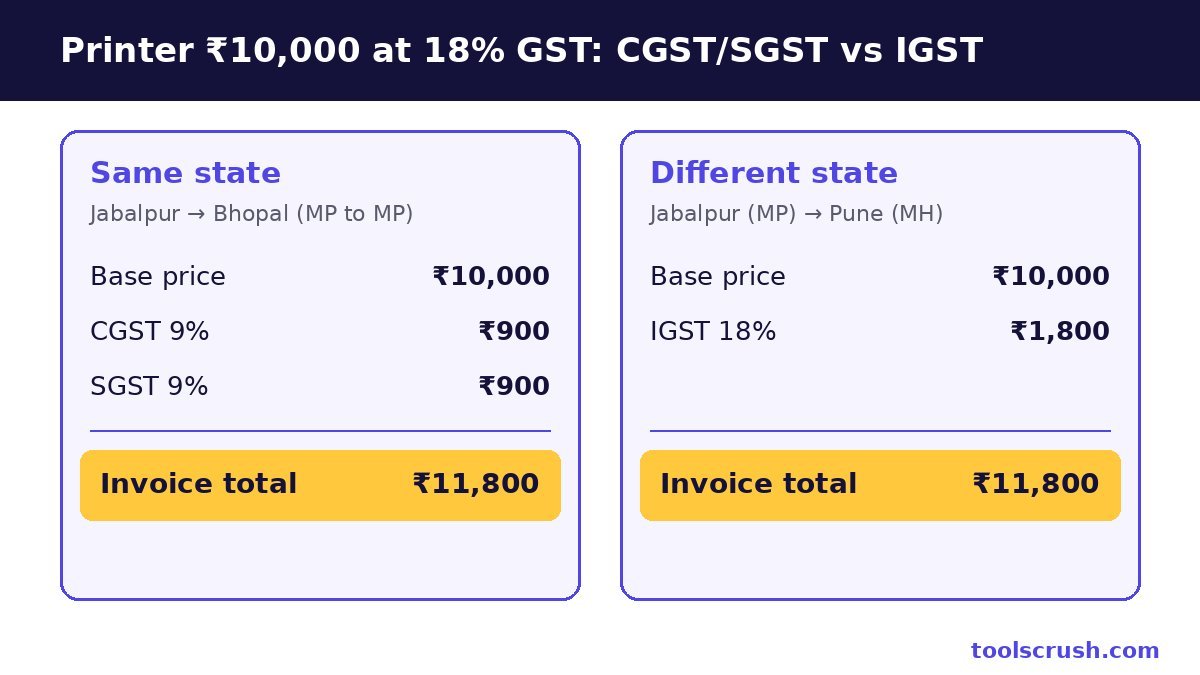
A shop in Jabalpur sells a printer for ₹10,000 (exclusive) to a customer in Bhopal at 18%.
- Total GST = ₹10,000 × 18% = ₹1,800
- CGST (9%) = ₹900, SGST (9%) = ₹900
- Invoice total = ₹11,800
Example 2: Sale from Madhya Pradesh to Maharashtra
The same shop sells the same printer to a buyer in Pune.
- IGST (18%) = ₹1,800
- Invoice total = ₹11,800
The customer pays the same ₹11,800 either way. Only the split on the invoice is different.
Example 3: Reverse GST calculation with a split
A customer in Indore paid ₹2,100 including 5% GST for a household item bought locally.
- Base price = ₹2,100 × 100 ÷ 105 = ₹2,000
- Total GST = ₹100, so CGST 2.5% = ₹50 and SGST 2.5% = ₹50
Example 4: Sale inside a Union Territory
A seller in Chandigarh, a Union Territory without its own legislature, bills a local customer ₹20,000 + 18% GST. The GST is ₹3,600, shown as ₹1,800 CGST + ₹1,800 UTGST. The invoice total is ₹23,600.
How does GST calculation work with a discount?
Under Section 15 of the CGST Act, a discount given before or at the time of sale, and shown on the invoice, is taken off the price before GST is worked out. So the correct order for GST calculation is: price, minus discount, then add GST.
Example: a mixer has a list price of ₹5,000 and the shop gives a 10% discount on the bill. GST is 18%.
- Discounted price = ₹5,000 − ₹500 = ₹4,500
- GST = ₹4,500 × 18 ÷ 100 = ₹810
- Correct total = ₹5,310
The common wrong way is to add GST on ₹5,000 (₹900) and then subtract ₹500, which gives ₹5,400. The customer pays ₹90 too much. A discount given after the sale follows stricter conditions under the same section, so ask your accountant before reducing tax on a later discount or credit note.
What does a GST invoice look like? (Worked example)
Here is a simple tax invoice from a shop in Jabalpur to a customer in the same city, so CGST and SGST apply. It has items at two different rates, which is very common.
| Item | Qty × Rate | Taxable value | GST rate | CGST | SGST | Total |
|---|---|---|---|---|---|---|
| 32-inch LED TV | 1 × ₹25,000 | ₹25,000 | 18% | ₹2,250 | ₹2,250 | ₹29,500 |
| Toothpaste | 4 × ₹100 | ₹400 | 5% | ₹10 | ₹10 | ₹420 |
| Hair oil | 2 × ₹150 | ₹300 | 5% | ₹7.50 | ₹7.50 | ₹315 |
| Invoice total | ₹25,700 | ₹2,267.50 | ₹2,267.50 | ₹30,235 |
The total GST on this bill is ₹4,535. Notice that the GST calculation is done line by line, each at its own rate. You cannot apply one rate to the whole bill when items fall in different slabs.
What a tax invoice should show
- Seller’s name, address and GSTIN (and the buyer’s GSTIN for a business sale)
- Invoice number and date
- HSN code for goods or SAC code for services
- Description, quantity and taxable value of each item
- GST rate and the CGST, SGST or IGST amount for each item
- Place of supply (state name), which decides the tax split
GST calculation in real life: 4 everyday scenarios
Freelancer sending an invoice
A GST-registered designer in Jabalpur charges a client in Bengaluru ₹30,000 for a website project. Most professional services sit in the 18% standard slab. Since the client is in another state, the invoice shows ₹5,400 IGST and a total of ₹35,400. If the client were in Madhya Pradesh, it would be ₹2,700 CGST + ₹2,700 SGST.
Buying gold jewellery
Gold is taxed at 3%. If the gold value of a chain is ₹85,000, the GST on that value is ₹2,550. Do the GST calculation on each line separately: jewellers often show making charges as a separate line, and those may be taxed differently, so read each line of the bill.
Checking an MRP in a shop
A pack of soap has an MRP of ₹105 and soap bars are now at 5% GST. Since MRP is inclusive, the base price is ₹105 ÷ 1.05 = ₹100, and the GST inside is ₹5. You never add GST on top of an MRP, because the GST calculation is already done inside it.
Buying a new AC
Air conditioners moved from 28% to 18%. If a shop quotes ₹30,000 + GST, the GST is ₹5,400 and you pay ₹35,400. If the same AC is quoted at ₹35,400 “inclusive”, a quick reverse GST calculation (₹35,400 ÷ 1.18) confirms the base price of ₹30,000.
Common GST calculation mistakes to avoid
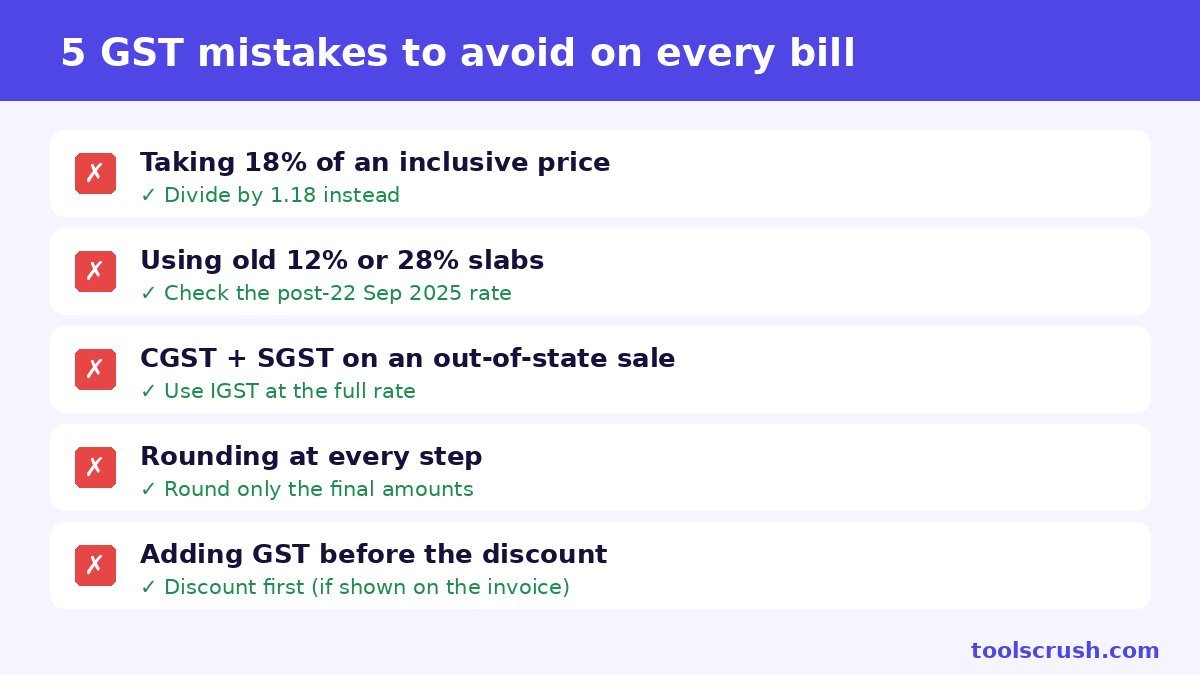
- Taking a percentage of the inclusive price. 18% of ₹1,180 is not the GST. Divide by 1.18.
- Using an old slab. Many items that were at 12% or 28% moved after 22 September 2025. Old price lists and old blog posts may still show 12% or 28%.
- Charging CGST + SGST on an inter-state sale. Out-of-state sales use IGST.
- Rounding too early. Do the GST calculation with the full figure and round only the final invoice amounts.
- Adding GST before the discount. Take off an invoice discount first, then add GST.
- Using one rate for a mixed bill. Each item is taxed at its own rate.
- Guessing the rate. The same product family can sit in different slabs. Check the HSN/SAC code before any GST calculation.
Glossary: GST terms in simple words
- GSTIN: the 15-character GST registration number of a business.
- HSN code: the code that classifies goods and decides their rate.
- SAC code: the code that classifies services.
- Taxable value: the price on which GST is charged, after invoice discounts.
- Input tax credit (ITC): GST a registered business paid on its purchases, which it can set off against the GST it collects, subject to the rules.
- Place of supply: the state where the supply is treated as made. It decides IGST versus CGST + SGST.
- Composition scheme: a simpler scheme for small businesses. They pay tax at a low fixed rate on turnover and cannot charge GST on their bills.
For registration, returns and your GSTIN details, the official taxpayer site is the GST portal (gst.gov.in).
Key takeaways
- Add GST: Total = Base × (100 + Rate) ÷ 100. ₹1,000 at 18% = ₹1,180.
- Remove GST: Base = Total × 100 ÷ (100 + Rate). ₹1,180 at 18% = ₹1,000 base.
- Since 22 September 2025, the main GST rates are 5% and 18%, with 40% for selected luxury and sin goods, plus nil, 3% (gold, silver) and 0.25% (diamonds and precious stones).
- Same-state sale: CGST + SGST, half each. Different-state sale: IGST at the full rate.
- Take invoice discounts off first, then do the GST calculation.
- Do the GST calculation line by line when a bill has items in different slabs.
- Use the ToolsCrush GST Calculator to avoid mistakes on every bill.
Related free tools: need a discount or profit percentage too? Try the Percentage Calculator. Paying for a big purchase in instalments after your GST calculation? See our EMI Calculator. Working out a payment due date on an invoice? Read what date is 30 days from today. You can find every free tool in our guide to free online tools.
GST calculation FAQs
How do I calculate 18% GST on ₹1,000?
Multiply ₹1,000 by 18 and divide by 100. The GST is ₹180, so the total price is ₹1,180.
How do I remove 18% GST from a total amount?
Divide the total by 1.18. For example, ₹5,900 ÷ 1.18 = ₹5,000 base price, and the GST inside it is ₹900.
What is the formula for GST calculation?
To add GST, use GST = Base Price × Rate ÷ 100 and add it to the base price. To remove GST from an inclusive price, use Base Price = Total × 100 ÷ (100 + Rate).
What are the GST slabs after 22 September 2025?
The main rates are 5% (merit rate) and 18% (standard rate), with a special 40% rate for selected luxury and sin goods. Some items are exempt (0%), gold and silver are at 3%, and diamonds and precious stones are at 0.25%. Check the official notification for your exact item.
Is 12% or 28% GST still applicable?
The GST Council removed the 12% and 28% slabs for most goods and services from 22 September 2025. Tobacco products such as cigarettes and pan masala followed a separate timeline, so check the latest CBIC notification for those.
When do I charge IGST instead of CGST and SGST?
Charge IGST when the seller and the place of supply are in different states. Charge CGST plus SGST, split equally, when both are in the same state.
Is GST charged before or after a discount?
A discount given at the time of sale and shown on the invoice is deducted first, and GST is charged on the reduced price. For example, ₹5,000 minus a 10% discount is ₹4,500, and 18% GST on that is ₹810.
Is the GST calculator on ToolsCrush free?
Yes. The ToolsCrush GST Calculator is free, needs no sign-up and lets you add or remove GST at any rate in seconds.
Sources: Press Information Bureau release on the 56th GST Council meeting (3 September 2025); GST rate notifications on the CBIC GST portal. This article is for general information. For your exact product rate, check the official notification or a tax professional.