
What Date Is 30 Days From Today? Calculate the Exact Date
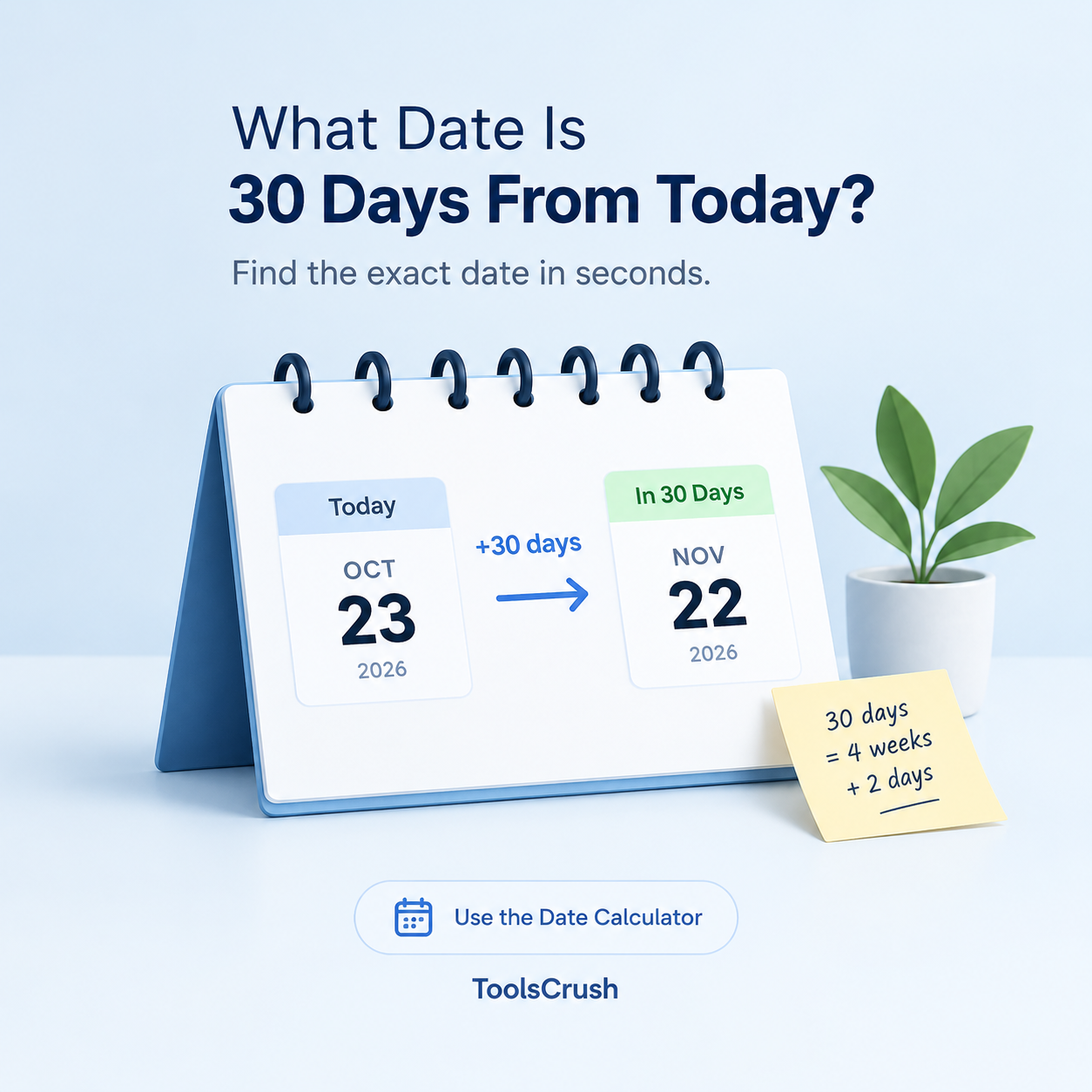
What date is 30 days from today? If today is October 23, 2026, the date 30 days from today is Sunday, November 22, 2026.
Thirty days from today means adding 30 calendar days to the current date. The calculation includes weekdays, Saturdays, Sundays, and public holidays. The starting date is treated as day zero, so the first day counted is tomorrow.
Whether you are calculating a deadline, planning a trip, tracking a payment, or preparing for an upcoming event, understanding how to calculate a date 30 days from today can help you plan accurately.
You can use the ToolsCrush Date Calculator to calculate dates by adding or subtracting a number of days from a starting date.
What Date Is 30 Days From Today?
The answer changes every day. For this article’s example, the starting date is October 23, 2026.
| Calculation | Result |
|---|---|
| Today’s date | October 23, 2026 |
| Days to add | 30 calendar days |
| Date 30 days from today | November 22, 2026 |
| Day of the week | Sunday |
| Total duration | 4 weeks and 2 days |
This result uses standard calendar-day counting, where today is not counted as the first completed day.
For a different starting date, add 30 calendar days to that date. The resulting day and month will depend on the starting date and the number of days in the months crossed.
How to Calculate 30 Days From Today
You can calculate the date 30 days from today manually or use an online date calculator.
Method 1: Use an online date calculator
Follow these steps to calculate a date 30 days in the future:
- Open the ToolsCrush Date Calculator.
- Select today’s date or enter another starting date.
- Choose the option to add days, if available.
- Enter 30 as the number of days.
- Calculate the result and check the displayed date.
Confirm that you are adding calendar days rather than working days. These calculations can produce different results because working-day calculations usually skip weekends and may also exclude public holidays.
Method 2: Calculate the date manually
To calculate 30 days from a date manually, move forward through the calendar one day at a time or count the remaining days in the current month and then continue into the next month.
For example, October has 31 days. Starting from October 23, there are 8 days until October 31 when measuring the elapsed difference. The remaining 22 days take you into November.
Therefore:
October 23, 2026 + 30 days = November 22, 2026.
An online calculator can make this process easier, especially when the calculation crosses several months or a year boundary.
Is 30 Days the Same as One Month?
No. Thirty days and one calendar month are not always the same length of time.
A calendar month can contain 28, 29, 30, or 31 days. Adding 30 days means counting forward by exactly 30 calendar days, whereas adding one month means moving to the corresponding date in the following month, subject to how the calendar handles dates that do not exist in that month.
For example, from October 23, 2026:
- Adding 30 days gives November 22, 2026.
- Adding one calendar month gives November 23, 2026.
The difference is one day in this example.
This distinction matters when calculating deadlines, payment dates, subscription periods, notice periods, or other dates defined by a specific number of days or calendar months.
If an agreement specifies 30 days, do not automatically interpret it as one month. Check the wording and any applicable counting rules.
Does 30 Days From Today Include Today?
In standard date arithmetic, no. Today is the starting date, or day zero. Tomorrow is day one, and the date 30 days later is day 30.
However, some tasks use inclusive counting, where the starting date is counted as day one.
For example, if October 23 is counted as day one, the 30th calendar date in the sequence is November 21, 2026. By contrast, adding 30 elapsed calendar days to October 23 gives November 22, 2026.
This one-day difference can matter for official forms, application deadlines, employment notices, and other time-sensitive situations.
Always confirm whether the applicable instructions use elapsed-day counting or inclusive counting before relying on the result.
What Date Is 30 Working Days From Today?
Thirty working days is different from 30 calendar days.
Calendar-day calculations include every day of the week. Working-day calculations typically count Monday through Friday and exclude Saturdays and Sundays. Some calculations also exclude public holidays, depending on the country or calendar settings.
Because 30 working days usually spans more than six calendar weeks, its result is later than the date 30 calendar days from today.
The exact result depends on the starting date, weekends, and which holidays are excluded. If you are calculating a business deadline, use a calculator that supports working days and the relevant holiday calendar.
Do not use a calendar-day result as a substitute for a working-day deadline.
Why Do People Calculate 30 Days From Today?
1. Payment and invoice planning
Businesses and individuals may need to estimate a future payment date or track an invoice with a 30-day term. Check the invoice or agreement to determine how the period is counted and whether weekends or holidays affect payment processing.
2. Project planning
A 30-day period can help establish a project milestone, review date, or target completion date. Calculating the date in advance makes it easier to organise tasks and track progress.
3. Travel and event planning
You can calculate a date 30 days ahead when planning a trip, booking an appointment, or preparing for an event. Remember that the resulting date may fall on a weekend or public holiday.
4. Subscription and trial periods
Some subscriptions and promotional offers specify a period in days. Calculate the expected end date, but review the provider’s terms for the exact start time, cancellation deadline, and time zone.
5. Application and document deadlines
A 30-day period may appear in application instructions, notices, or document requirements. The relevant authority may define special rules for the first day, weekends, or public holidays, so verify the official deadline before acting.
6. Personal goals
You can use a 30-day period to plan a learning schedule, fitness routine, reading goal, or other personal project. Knowing the end date helps you set a clear target.
Common Mistakes When Calculating 30 Days From Today
Confusing 30 days with one month. A month does not always contain 30 days. Add days when the requirement specifies days, and add calendar months when the requirement specifies months.
Counting today as day one without checking. Standard date addition treats the starting date as day zero. Inclusive counting may produce a date one day earlier.
Ignoring weekends. Calendar days include Saturdays and Sundays. If the requirement refers to working days, use a calculation that excludes the appropriate non-working days.
Forgetting public holidays. A calendar-day calculation normally includes public holidays. Official deadlines may follow different rules.
Using an outdated date. The answer to “what date is 30 days from today” changes daily. Always use the current date as the starting point when making a new calculation.
Assuming every deadline follows the same rule. Contractual, legal, employment, and government deadlines can use specific counting conventions. Check the relevant instructions.
Frequently Asked Questions
What date is 30 days from today?
The answer depends on today’s date. For October 23, 2026, adding 30 calendar days gives November 22, 2026. Recalculate from the current date whenever you read this article later.
How many weeks are 30 days?
Thirty days equals 4 weeks and 2 days because four weeks contain 28 days.
Is 30 days always the same date next month?
No. Adding 30 days and adding one calendar month are different operations. The result depends on the starting date and the length of the month.
What date is 30 days from a date I choose?
Enter your chosen starting date into a date calculator, select the option to add days, and enter 30. The result is the date 30 calendar days after that starting date.
Are weekends included when calculating 30 days?
Yes. Standard calendar-day calculations include Saturdays and Sundays, as well as public holidays. Working-day calculations use a different counting method.
How can I calculate 30 days before today?
Use a date calculator that supports subtracting days. Enter the starting date and subtract 30 calendar days to find the date 30 days earlier.
Can I use a date calculator for official deadlines?
A date calculator can help you estimate a date, but official deadlines may have specific rules for inclusive counting, weekends, holidays, and time zones. Verify the official instructions before relying on the result.
Calculate Your Future Date With ToolsCrush
Need to find a date 30 days from today or calculate a different period? Use the ToolsCrush Date Calculator to explore date calculations and find a date by adding or subtracting days from a starting date.
Whether you are planning a project, organising an event, or preparing for a deadline, confirm the starting date and counting method before using the result.
Try the ToolsCrush Date Calculator and make your next date calculation easier.
Explore More Date Calculator Tools
Need to calculate a different date or find out how long a period lasts? Depending on your task, you may need more than a 30-day date calculation. These related date calculator tools and guides can help you plan deadlines, track events, and work with calendar dates more easily.
1. Days Between Two Dates Calculator
Want to know how many days separate two dates? A days-between-dates calculator helps you calculate the elapsed time between a starting date and an ending date.
Use it when planning a trip, checking a project timeline, tracking an event, or calculating the duration between two important dates.
Related guide: How to Calculate the Number of Days Between Two Dates
Explore: ToolsCrush Date Calculator
2. What Date Is 60 Days From Today?
If you are planning further ahead, calculating 60 days from today can help you estimate a future deadline, payment date, or project milestone.
Remember that 60 calendar days and two calendar months are not always the same. Use the exact number of days specified by your requirement.
Related guide: What Date Is 60 Days From Today?
3. What Date Is 90 Days From Today?
A 90-day period is useful for planning quarterly goals, project reviews, personal targets, and other longer-term activities.
The resulting date depends on the starting date. To calculate it accurately, add 90 calendar days rather than assuming that three months always equal 90 days.
Related guide: What Date Is 90 Days From Today?
4. Add or Subtract Days From a Date
Sometimes you need to calculate a date in the future; other times, you need to work backwards from a deadline. Adding or subtracting days helps you find the date that falls a specified number of calendar days before or after a starting date.
For example, you can calculate a date 14 days before an appointment or 45 days after a project begins.
Explore: ToolsCrush Date Calculator
5. Working Days Calculator
Calendar days include weekends and holidays, while working-day calculations usually exclude weekends. Public holidays may also need to be excluded, depending on the rules and calendar used.
A working-days calculator is useful for estimating business timelines, delivery schedules, and administrative deadlines. Always check which weekends and holidays the calculator excludes.
6. Weeks Between Two Dates
Need to measure a period in weeks rather than days? Dividing the elapsed days by seven gives you the number of complete weeks and any remaining days.
For example, 30 days equals four weeks and two days. This format can be useful for study plans, project schedules, and personal goals.
7. Months Between Two Dates
Calculating months between two dates requires attention to calendar-month lengths. A month may contain 28, 29, 30, or 31 days, so converting a number of days into months is not always exact.
Use calendar-month calculations when a schedule is defined in months, and use day-based calculations when the requirement specifies an exact number of days.
7.Salary to Hourly Wage Calculator
Calculating months between two dates requires attention to calendar-month lengths. A month may contain 28, 29, 30, or 31 days, so converting a number of days into months is not always exact.
Use calendar-month calculations when a schedule is defined in months, and use day-based calculations when the requirement specifies an exact number of days.
you can go to banex digital as well for more digital work
Which Date Calculator Should You Use?
Choose the calculation that matches your task:
- Find a future date: Add a specified number of days to a starting date.
- Find a past date: Subtract days from a starting date.
- Calculate a date difference: Enter a start date and an end date.
- Plan a business deadline: Check whether working days and public holidays need to be considered.
- Measure a duration in weeks or months: Use a calculator that provides the required breakdown.
For a quick starting point, visit the ToolsCrush Date Calculator and explore its available features.